How Many Calories Does Running Burn?
Running calorie burn comes from a MET value, body mass and duration. This guide works the formula through step by step, shows why two well-sourced calculators can differ by 19% on the identical run, and sets out where the estimate holds and where it drifts.
JCVerified Verified by Jobi Cheriyan, Founder & Builder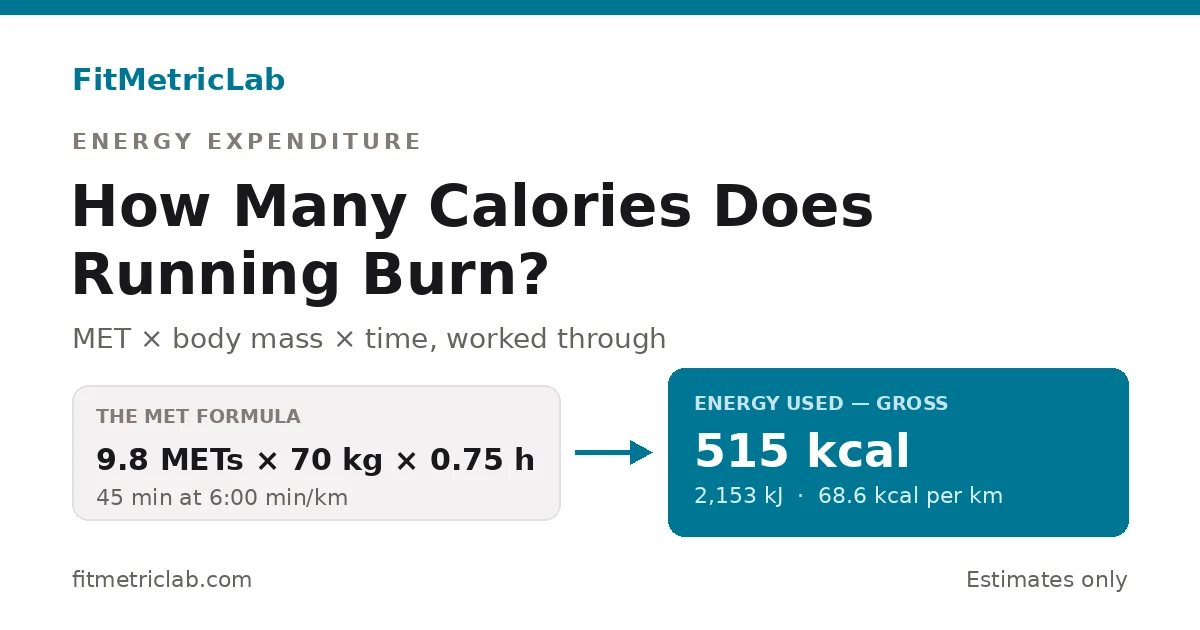
A 70 kg (154 lb, 11 st) runner going out for 45 minutes at 6:00 min/km, that's 10 km/h, 6.2 mph, or roughly 9:39 per mile, covers 7.5 km and uses about 515 kcal (2,153 kJ). Change the body mass, the pace or the clock and that number moves. Everything else in this article is an explanation of where 515 comes from, and how far the number can be trusted. That is the short answer to how many calories does running burn; the long answer is the part that matters.
Short version: it comes from three numbers and one lookup table. The running calorie burn calculator does the arithmetic, but the arithmetic was never the hard part. The hard part is knowing what the answer is worth, and that is where most guides on this topic stop.
What running calorie burn actually measures
Running calorie burn is an estimate of the total energy your body uses while running. It is reported in kilocalories (kcal) or kilojoules (kJ), depending on where you live. Food labels in the EU, UK, Ireland, Australia and New Zealand print both. Labels in the United States and Canada print Calories with a capital C, which is the same quantity as one kilocalorie. One kcal is 4.184 kJ, and nothing else about the maths changes between regions.
Behind the estimate sits a MET value. Metabolic equivalent of task. It is a ratio. One MET is the cost of sitting quietly; an activity rated at 9.8 METs costs roughly 9.8 times that.
The word "roughly" is doing real work in that sentence. MET values are population averages collected in laboratories using indirect calorimetry, then compiled into the Compendium of Physical Activities. The compilers are unusually blunt about the limits of their own work: the Compendium's documentation states plainly that it was not developed to determine the precise energy cost of activities within an individual, and that it is frequently used outside that original scope. A calorie estimate for your run is exactly that kind of use.
Why the number is worth estimating at all
If a MET table cannot tell you what you personally burned, what is it for? Comparison.
The MET system was built so that a 45 minute run and a 45 minute ride could be placed on the same scale. That is still its best use. The absolute figure carries real uncertainty; the ratio between two sessions computed the same way carries much less, because the same assumptions and the same errors sit on both sides.
The same logic works across a training block. If weekly distance is flat but the estimated weekly energy cost is climbing, something in the sessions has changed. Usually pace. Tracked consistently over months, the trend is informative even when any single week's figure is not.
Treat it as a unit of comparison rather than a measurement and it does useful work. Treat it as a reading off a meter and it will mislead you.
How the estimate is calculated
FitMetricLab's tools use the Compendium's own conversion, which is about as simple as sports science gets:
Energy (kcal) = MET × body mass (kg) × duration (hours)Where:
- MET = the intensity value for your pace, unitless, taken from a published table. The MET value for running rises with speed, from 7.0 at a gentle jog to 15.5 at 4:00 min/km.
- Body mass = in kilogrammes. From pounds, divide by 2.205; from stone, multiply by 6.35.
- Duration = time actually running, in hours. Forty five minutes is 0.75.
That formula rests on the definition that one MET equals 1 kcal per kilogram of body mass per hour. Sit still for an hour at 70 kg and you use roughly 70 kcal. Run at 9.8 METs for that hour and you use roughly 9.8 times as much.
The MET value for running is the only part you cannot read off a watch, so the calculator assigns it from your pace. The bands it uses, in minutes per kilometre:
- 4:00 or faster: 15.5 METs
- 4:01 to 5:00 – 11.8 METs
- 5:01 to 6:00 – 9.8 METs
- 6:01 to 7:00 – 8.3 METs
- slower than 7:00 – 7.0 METs
A worked example, step by step
Take a 70 kg (154 lb) runner, 45 minutes, flat ground, holding 6:00 min/km throughout.
- Find the pace band. 6:00 min/km falls in the 5:01–6:00 band, which carries a MET value of 9.8.
- Convert duration to hours. 45 ÷ 60 = 0.75 hours.
- Multiply the three terms. 9.8 × 70 × 0.75 = 514.5 kcal.
- Round once, at the end. 515 kcal, or 2,153 kJ.
At 6:00 min/km for 45 minutes, that runner covers 7.5 km (4.66 miles). So the calories burned running per km work out at 514.5 ÷ 7.5 = 68.6 kcal per kilometre, or about 110 kcal per mile.
For the net figure, run the same sum at 1 MET: 1 × 70 × 0.75 = 52.5 kcal of resting baseline. Subtract that from 514.5 and you get 462 kcal of energy attributable to the running itself.
One habit worth keeping: round only at the end. Rounding 514.5 to 515 and then dividing by 7.5 gives 68.67 rather than 68.6. Trivial here, less trivial once you start stacking sessions.
Why two honest calculators disagree
Here is something most articles on this subject leave out, and it is the reason your figure may not match someone else's for the identical run.
The Compendium defines one MET two ways. It is 1 kcal per kilogram per hour. It is also an oxygen uptake of 3.5 millilitres per kilogram per minute. Both definitions are printed on the same reference page, and they are not the same number.
Follow the oxygen route: 3.5 ml/kg/min is 0.21 litres per kilogram per hour, and each litre of oxygen releases about 5 kcal. That works out at 1.05 kcal/kg/h, not 1.00. Any calculator built on the oxygen definition therefore returns figures exactly 5% higher than one built on the kilocalorie definition, from identical inputs, with neither of them wrong.
Then add the second variable: which MET value you pick. The 2011 Compendium put running at 6 mph at 9.8 METs. The 2024 update, which replaced many estimated values with measured ones, revised it to 9.3. Meanwhile the American College of Sports Medicine's running equation predicts oxygen uptake from speed directly: 0.2 × speed in m/min, plus a gradient term, plus 3.5, and at 10 km/h that returns 36.8 ml/kg/min, or 10.5 METs. Note that this equation is a separate prediction model, not the machinery underneath the Compendium tables, and the two genuinely disagree.
Stack those choices up for our 70 kg, 45 minute, 6:00 min/km run and the defensible answers run from about 488 kcal to about 580 kcal. That is a spread of roughly 19%, and every value in it comes from a peer-reviewed source.
Which is why the sensible way to read 515 kcal is "around 500", and why comparing two sessions from the same calculator is far more reliable than comparing one session across two apps.
How to use the Calorie Burn: Running tool
The Calorie Burn: Running calculator takes three inputs: body mass, session duration in minutes, and average pace. There is a metric/imperial toggle, so pounds and minutes per mile work as well as kilogrammes and minutes per kilometre. It returns a single gross figure in kilocalories.
Two things worth knowing before you read the output. The tool has no distance field. It works from pace and time, so a 7.5 km run logged as 45 minutes needs entering as 45 minutes at 6:00 min/km. And because MET values arrive in bands rather than a curve, any pace between 5:01 and 6:00 returns the same MET. Shaving four seconds per kilometre inside a band changes nothing at all.
For a pace, surface or activity the standard bands do not cover, the custom activity MET calculator accepts a MET value directly, which lets you use a specific Compendium code. Including the uphill and downhill entries discussed below.
How many calories does running burn at different paces and weights?
Two runners, same pace, different body mass
Body mass is a straight multiplier in the formula, so this one is exactly proportional. Across 45 minutes at 6:00 min/km: a 55 kg (121 lb) runner lands at 404 kcal, a 70 kg runner at 515 kcal, and a 90 kg (198 lb) runner at 662 kcal. Same route, same pace, same effort as far as the clock is concerned, and a 257 kcal spread between the lightest and heaviest.
Same 45 minutes, different pace
Hold the clock still and raise the pace, and the MET value jumps a band. Forty five minutes at 7:30 min/km (8 km/h) returns 368 kcal for a 70 kg runner. The same 45 minutes returns 515 kcal at 6:00 min/km and 620 kcal at 5:00 min/km. That is a 69% range from the slowest to the fastest.
A fixed distance, run fast or run slow
Now fix the distance instead, and the picture inverts almost completely. A 70 kg runner covering 10 km at 6:00 min/km takes an hour and lands at 686 kcal. The same 10 km at 5:00 min/km takes 50 minutes and lands at 688 kcal. Two kilocalories apart. A difference of 0.3%.
Drop to 7:30 min/km and the 10 km takes 75 minutes and returns 613 kcal, about 11% below the fast run, mostly because the slowest band steps down to 7.0 METs. So distance dominates the total for most recreational running, though not quite as cleanly as the popular "a mile is a mile" shorthand suggests.
Running against walking and cycling
Same formula, different MET table. Across 45 minutes at 70 kg: walking at 5 km/h returns 226 kcal, cycling at 20 km/h returns 420 kcal, and running at 10 km/h returns 515 kcal.
Compare over distance instead and the running-versus-walking gap collapses. Covering the same 7.5 km on foot at 5 km/h takes 90 minutes and returns 452 kcal, against 515 kcal for the 45 minute run. Roughly 14% apart, not the 2.3× the time-matched comparison suggested. The calorie burn: walking and calorie burn: cycling tools keep both comparisons on the same basis, and the activity calorie comparison calculator lines several up at once.
What hills do to the number
Every figure above assumes flat ground, and the flat-ground tables understate hill running badly. This is not a rounding issue.
The 2024 Compendium carries separate gradient entries, and the numbers are stark. Running at 6 mph on the flat is 9.3 METs. Running at 6 mph up a 5% incline is 13.3 METs. About 43% more energy for the same speed on the clock. At a 15% incline the listed values pass 17.
Downhill goes the other way, and further than most people expect. Minetti and colleagues measured the energy cost of running across gradients from −45% to +45% and put level running at 3.40 J per kilogram per metre. That cost falls to a minimum of 1.73 J/kg/m at a −20% gradient (roughly half the flat figure) before climbing again on steeper descents, reaching 3.92 J/kg/m at −45%. Studies place the running minimum somewhere between −10% and −20%. The mechanism is efficiency: eccentric, braking muscle work is several times cheaper than concentric, lifting work.
The Compendium's downhill codes are less useful here than the underlying research. Its −10% to −15% entry at 6.0 to 6.9 mph reads 7.5 METs, but that one is flagged as an estimated rather than a measured value, and its speed bands do not align with the flat-ground bands, so the two are not directly comparable.
The practical consequence: a loop with equal climbing and descending does not average back to the flat figure. Uphill cost rises far more steeply than downhill cost falls, so the loop total sits above it.
Common mistakes and misconceptions
- Treating an estimate as a measurement. Indirect calorimetry measures energy expenditure. A MET table estimates it, using an average drawn from people who are not you.
- Mixing units. Entering 154 into a field expecting kilogrammes inflates the result by a factor of 2.2. Scales report kilogrammes, pounds and stone depending on the country, and the field label is worth a second look.
- Comparing a gross figure against a net one. A watch reporting net and a calculator reporting gross will differ by the resting baseline: 52.5 kcal across 45 minutes at 70 kg.
- Expecting pace to scale smoothly. MET values sit in bands. Inside a band, a small pace change moves the estimate not at all; crossing a boundary moves it in a step.
- Reading a flat-ground figure on a hilly route. Covered above, and worth repeating, because it is the largest single error most runners make with these tools.
- Comparing figures across apps. Different MET tables and different MET definitions produce a legitimate 19% spread. A mismatch between two apps is not evidence that either is broken.
Frequently asked questions
How many calories does running burn per km?
For a 70 kg (154 lb) runner at 6:00 min/km, the calories burned running per km come to 68.6 kcal (287 kJ), or about 110 kcal per mile. A shortcut that holds up well on flat ground: the cost lands near one kilocalorie per kilogram of body mass per kilometre. The exact ratio here is 0.98. On that basis a 55 kg (121 lb) runner sits nearer 54 kcal per kilometre and a 90 kg (198 lb) runner nearer 88. Distance does most of the work in this figure rather than speed, because a faster pace covers the same ground in proportionally less time. The estimate drifts upward on hills and is not reliable on technical terrain. The running calorie burn estimator reports the session total, from which the per-kilometre figure follows directly.
Does running burn more calories than walking?
Over the same block of time, comfortably yes. Walking at 5 km/h carries a MET value of 4.3 in the calculator; running at 10 km/h carries 9.8. For a 70 kg (154 lb) person across 45 minutes that is 226 kcal against 515 kcal, a factor of 2.3. Over the same distance the gap narrows to almost nothing, because walking a route simply takes longer. Covering 7.5 km on foot at 5 km/h takes 90 minutes and returns 452 kcal, only about 14% below the run. Which comparison matters depends entirely on whether time or distance is the thing being held constant, and that is worth deciding before reading either number.
Do heavier runners burn more calories running?
Body mass is a direct multiplier in the formula, so the estimate scales exactly in proportion: at the same pace and duration, doubling body mass doubles the figure. Across 45 minutes at 6:00 min/km the estimate moves from 404 kcal at 55 kg (121 lb) to 662 kcal at 90 kg (198 lb). The formula's proportionality is exact; the underlying physiology is not quite. The Compendium's own documentation on corrected MET values notes that the standard 3.5 ml/kg/min baseline tends to sit above measured resting metabolic rate, and that the resulting underestimation of activity intensity is larger in people who are heavier, older or less fit. The standard figure works as a central estimate rather than a personal one.
Why does my watch show a different number?
Wearables rarely use the plain MET method. Most blend heart rate, accelerometer data, profile fields and a proprietary model, and many report net energy rather than gross. A 52.5 kcal difference for a 70 kg person across 45 minutes, before any modelling differences. Devices also handle terrain, wind, temperature and individual running economy differently, and running economy differs meaningfully between people at identical pace and mass. Two figures for the same session can both be reasonable estimates built on different assumptions. Reading a watch figure against a MET calculation works as a sanity check, not as a verdict on either one.
Sources and methodology
MET values and the kilocalorie conversion come from the Compendium of Physical Activities, which catalogues measured oxygen cost across more than a thousand activities and publishes the running, walking and cycling tables referenced here. The peer-reviewed 2024 Adult Compendium paper in the Journal of Sport and Health Science documents the third update, in which 82% of activities now carry measured rather than estimated MET values.
The discussion of individual variation draws on the Compendium's own corrected METs documentation, which sets out the case for adjusting the standard 3.5 ml/kg/min baseline using measured or predicted resting metabolic rate, and the objections to doing so. The alternative oxygen-uptake model referenced above is the running metabolic equation published by the American College of Sports Medicine in ACSM's Guidelines for Exercise Testing and Prescription, 12th edition, Appendix C. Gradient figures come from Minetti and colleagues in the Journal of Applied Physiology, who measured running cost across slopes from −45% to +45%.
The calculator applies MET × body mass (kg) × duration (hours), with the MET value for running assigned by pace band and sourced from the 2011 Compendium: where this article quotes 2024 values, they are labelled as such. Every figure here was computed from the formula shown and rounded once.
Putting it together
How many calories does running burn comes down to three inputs and one lookup table. A MET value sets the intensity, body mass scales it, duration finishes it. For a 70 kg (154 lb) runner holding 6:00 min/km for 45 minutes, that comes to 515 kcal (2,153 kJ), and a defensible range of roughly 488 to 580 depending on which published source you build from.
The patterns underneath are more durable than the number itself. Body mass scales the total proportionally. Distance drives it more than speed does. Gross sits above net by the resting baseline. Uphill cost rises far more steeply than downhill cost falls, so hilly routes sit above the flat estimate.
Read as a consistent reference point rather than a meter reading, the figure does what it was designed to do: let one session be compared against another.
Last updated 6 August 2026.