Maximum Heart Rate: The 220-Minus-Age Formula and Its Limits
Maximum heart rate is a ceiling set mostly by age, not a measure of fitness. For a 55-year-old the three published formulas return 165, 170 and 158 bpm, and because zones are percentages that twelve-beat spread travels into every band built on top.
JCVerified Verified by Jobi Cheriyan, Founder & Builder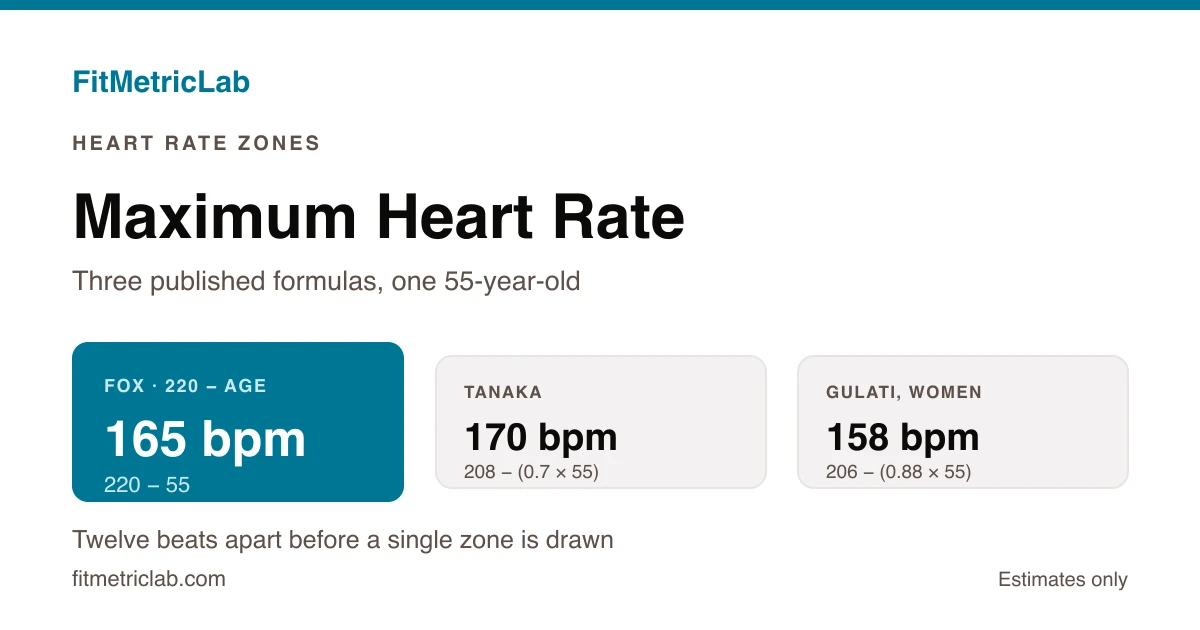
Two runners set a watch alarm at 140 beats per minute. For a 25-year-old that is 72% of an estimated maximum; for a 55-year-old it is 85%. Neither figure was measured, and the gap between them is arithmetic rather than fitness: both came from subtracting an age from 220. Anyone working out how to calculate max heart rate meets that subtraction first, and the max heart rate calculator (220 minus age) returns it in a single step. A formula published three decades later puts that 55-year-old five beats higher.
What maximum heart rate actually is
Maximum heart rate is the highest rate the heart reaches during all-out effort, counted in beats per minute. It is a ceiling set largely by age and individual physiology, and it is not a measure of fitness: two people of the same age can be separated by twenty beats while training identically, and a fitter person does not reliably have a higher maximum. Measuring it properly takes a graded exercise test to true exhaustion, usually in a laboratory or clinic. Everything else, including every age-based formula, is an estimate of the population average for that age rather than a reading of one heart.
Why one number anchors every intensity band
Heart-rate zones are expressed as percentages, so they inherit whatever maximum they were built on. A zone described as 70 to 80% is not a fixed range of beats; it is a fraction of an estimate, and an error in that estimate shifts every zone by the same proportion.
That is why the same alarm at 140 bpm lands in different places for different people, and why two watches can disagree about which zone a session was in while both are counting correctly. The disagreement is upstream, in the assumed maximum, and the bands shown by a heart rate zones (% of max) breakdown move with it.
How to calculate max heart rate
The classic method subtracts age from 220. It comes from a 1971 review by Fox, Naughton and Haskell, where it was offered as a rough fit to existing data rather than as a derived equation, and it has survived on ease of recall.
A 2001 analysis by Tanaka, Monahan and Seals pooled a much larger body of data and produced a different line, flatter with age. Both are single-variable equations taking age alone:
Fox (220 minus age)   MHR = 220 - a

Tanaka               MHR = 208 - (0.7 x a)

Gulati (women)       MHR = 206 - (0.88 x a)
The variables:
- a (years) — age, the only input any of the three takes
- MHR (bpm, beats per minute) — the estimated maximum; the unit is the same worldwide, so no imperial conversion applies
None of the three uses body mass, height, sex beyond the Gulati equation's own population, or training history. That is the whole of their simplicity and the whole of their limitation.
Nor are these the only three. Nes and colleagues derived 211 minus 0.64 times age from a large population study, which at 55 returns 176 bpm — above all three of the equations above, so the published spread at that age is wider still than the worked example shows.
A worked example
Take a 55-year-old. Fox first:
220 - 55 = 165 bpmTanaka, on the same age:
208 - (0.7 x 55) = 208 - 38.5 = 169.5, which rounds to 170 bpmAnd the Gulati equation, derived in women:
206 - (0.88 x 55) = 206 - 48.4 = 157.6, which rounds to 158 bpmThree published formulas, one age, and a spread of twelve beats from 158 to 170. Carry that through to a zone and the spread travels with it: 80% of 158 is 126 bpm, while 80% of 170 is 136. Only the final figures are rounded; the intermediate values keep their decimals.
How to use the Max Heart Rate Calculator (220 Minus Age)
Only one field needs filling. The 220 minus age max heart rate calculator takes:
- Age (years) — a whole number, accepted from 10 to 100
Entering 55 returns 165 bpm, with two intensity bands underneath it:
- Moderate (50-70%) — 83 to 115 bpm
- Vigorous (70-85%) — 115 to 140 bpm
Those bands are percentages of the estimate above them, so they inherit its uncertainty rather than adding any precision of their own. Running the same age through the max heart rate calculator (tanaka formula) shows how far the ceiling moves on a different equation, which is a more honest picture than either figure alone. Where a measured or assumed maximum is already in hand, a target heart rate calculator works forwards from it to a band in beats.
Common scenarios
Setting up a new watch or chest strap
Most devices ask for a date of birth and quietly apply an age formula, often 220 minus age, to build their zones. Knowing which equation a device used explains why its zones can differ from another brand's on the same wrist, and why the zone labels on an exported file may not match a coach's.
Older athletes comparing the two equations
The gap between Fox and Tanaka widens with age. At 25 the two differ by around four beats; at 65 it is closer to eight, with 220 minus age returning the lower ceiling. For a masters athlete the choice of equation visibly changes where every zone boundary sits.
Comparing notes across sports
Maximum heart rate tends to read a few beats lower in cycling and lower again in swimming than in running, because posture and the mass of working muscle differ. A single estimate applied to all three sports is describing running more closely than the others, whatever the activity on the screen says.
Reconciling an estimate with a real session
Someone who has seen 178 bpm on a hard 5 km (3.11 mile) effort has observed something the formula cannot: an actual rate the heart reached. If the formula predicted 165, the measured figure is the better description of that heart, since a population average is being compared with a direct reading.
Common mistakes and misconceptions
- Treating the output as a measurement. It is a population average for an age. Individuals scatter widely around it, commonly by ten to twenty beats in either direction, which is larger than the whole of a typical zone.
- Reading it as a fitness score. A higher maximum is not a fitter heart. Maximum heart rate falls with age in trained and untrained people alike, and training a great deal does not raise the ceiling.
- Confusing maximum with resting or reserve. Resting heart rate is the count at complete rest; heart-rate reserve is the span between resting and maximum. Zones built on reserve, as in the Karvonen method, produce different beat ranges from zones built on a straight percentage of maximum.
- Assuming every device uses the same formula. Two watches reporting different zones for one session are often both correct about beats and simply disagreeing about the ceiling.
- Mixing a measured maximum with formula-based zones. If a genuine maximum has been observed, zones derived from 220 minus age no longer describe the same ceiling, and the two sets of numbers are not interchangeable.
Frequently asked questions
Is 220 minus age accurate?
As a description of a population it is serviceable; as a description of one person it is rough. The equation was presented in 1971 as a convenient fit to data already in hand rather than as a regression derived for the purpose, and later work with larger samples produced a flatter line. Individual maximums scatter around any age-based estimate by roughly ten to twenty beats either way, which is wider than a single training zone. The figure is best read as the centre of a broad range rather than a threshold, and a value observed during a genuinely maximal effort carries more information about one heart than any formula can.
Which formula gives the better estimate?
Tanaka's equation fits pooled data better across the adult age range, particularly past middle age, where 220 minus age tends to read low. The Gulati equation was derived specifically in women and returns lower figures again. None of the three is a measurement, so the practical answer is that the choice matters less than knowing which one produced a given number. Comparing two estimates for the same age shows the width of the uncertainty directly, which a single figure quietly hides.
Does maximum heart rate change with training?
Very little. Endurance training lowers resting heart rate and raises the output the heart delivers per beat, but the ceiling itself is largely fixed by age and individual physiology. Someone who trains for years will usually see resting rate fall and heart-rate reserve widen while the maximum stays close to where it was, drifting down slowly with age. A maximum that appears to rise after training more often reflects a first attempt that was not truly maximal than a change in the ceiling.
Why does my watch show a different maximum?
Devices differ in both the formula they apply and whether they update it from recorded sessions. Some stay with 220 minus age from the date of birth entered at setup; others raise the stored maximum when a session exceeds it, so the figure drifts upward over time. Optical wrist sensors can also misread during high intensity or in cold conditions, occasionally recording a rate that is a cadence artefact rather than a pulse. Checking which method a device uses explains most disagreements between two pieces of kit.
Can maximum heart rate be measured rather than estimated?
Yes. A graded exercise test to volitional exhaustion, with the rate recorded at the point of failure, is the direct method, and it is routinely carried out in laboratories and clinical exercise facilities. Field protocols exist as well, though they depend on genuinely reaching exhaustion, which is difficult to do unsupervised and carries risks that vary from person to person. Because those risks depend on individual circumstances and local clinical practice, arrangements for maximal testing are a matter for a qualified healthcare professional in the reader's own country.
Sources and methodology
Figures here come from the original publications of the three equations, and the arithmetic in the worked example was checked against the calculator's own engine. Where rounding is shown, intermediate values keep their decimals and only the final beats-per-minute figure is rounded to a whole number.
- Fox SM 3rd, Naughton JP, Haskell WL (1971). Physical activity and the prevention of coronary heart disease. Annals of Clinical Research 3(6):404-32, the review the 220-minus-age figure is traced to.
- Tanaka H, Monahan KD, Seals DR (2001). Age-predicted maximal heart rate revisited. Journal of the American College of Cardiology 37(1):153-6, for the 208 minus 0.7 times age equation and the pooled analysis behind it.
- Gulati M, Shaw LJ, Thisted RA, Black HR, Bairey Merz CN, Arnsdorf MF (2010). Heart rate response to exercise stress testing in asymptomatic women: the St James Women Take Heart project. Circulation 122(2):130-7, for the equation derived in women.
- Nes BM, Janszky I, Wisløff U, Støylen A, Karlsen T (2013). Age-predicted maximal heart rate in healthy subjects: the HUNT Fitness Study. Scandinavian Journal of Medicine and Science in Sports 23(6):697-704, for the fourth equation and the population it came from.
Putting it together
Maximum heart rate is a ceiling in beats per minute, set mostly by age, and it is not a measure of fitness. Subtracting age from 220 is the quickest estimate of it and the least precise: for a 55-year-old the three published equations return 165, 170 and 158 bpm, a spread of twelve beats before any zone is drawn. Because zones are percentages, that spread propagates into every band built on top. Running an age through the max heart rate estimator alongside a second equation shows the width of the uncertainty rather than hiding it behind one confident-looking number.
Last updated 29 October 2026.