Stride Length and Steps Per Mile Explained
A stride is two steps, and getting that factor of two wrong doubles or halves everything built on it. One lap of a track counted at 375 footfalls is worked through to a 106.7 cm step, a 213.3 cm stride and 1,509 steps to the mile.
JCVerified Verified by Jobi Cheriyan, Founder & Builder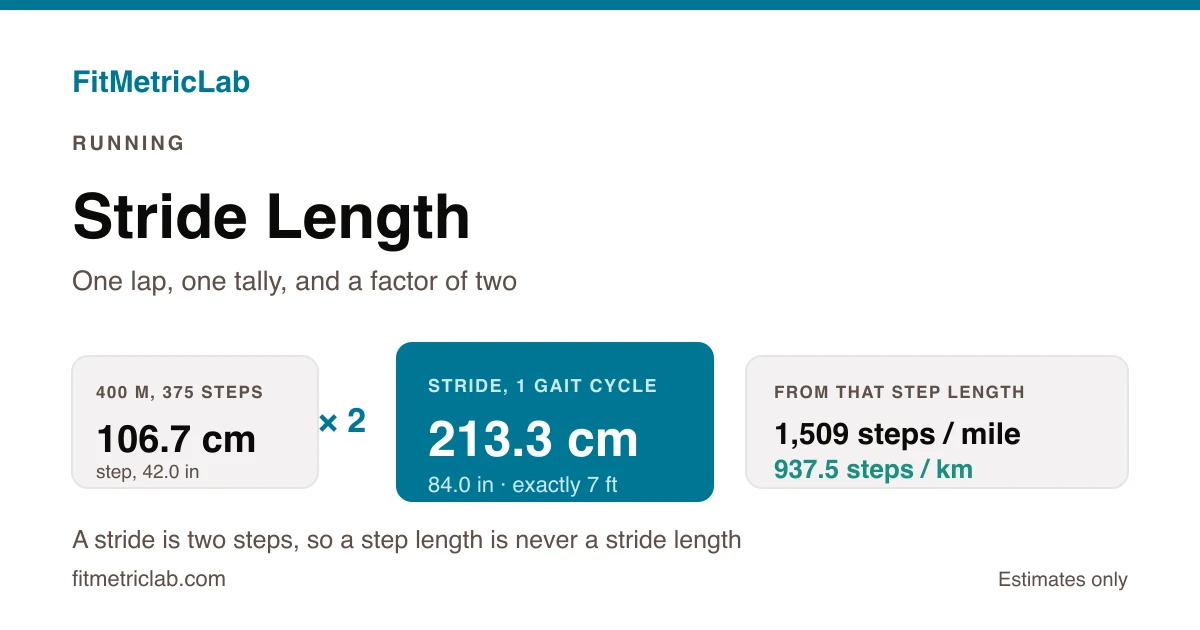
A watch reporting a 1.15 m (3.77 ft) stride has divided a distance by a step count, which makes it a step length whatever the label says: read as a gait cycle it would imply 57.5 cm (22.6 in) steps and 2,799 steps to the mile, a shuffle rather than a run. Knowing how to measure stride length yourself settles which of the two numbers you are holding, and it costs one lap and one tally of footfalls. The stride length calculator returns both lengths from one distance and one step count, and steps per mile is one more division after that.
How to measure stride length, in plain terms
A step runs from one footfall to the next, left to right. A stride is the full gait cycle, left contact round to the next left contact, so one stride contains two steps. Both are lengths, and they differ by a factor of exactly two.
Measuring either needs no equipment. Cover a distance you already know, count every footfall, then divide the distance by the count. That gives step length. Double it for stride length. Nothing is estimated, which is the point: the figure comes from a distance and a tally rather than a model of your body.
Why the step and stride distinction matters
The words get used interchangeably, and the cost is a figure wrong by a factor of two. Anything built on top inherits it: steps per mile doubles or halves, a treadmill calibration lands at the wrong belt speed, and a pedometer given a stride length where it wanted a step length reports about half the distance covered.
The conventions are not symmetrical either, which is the trap underneath the trap. Cadence is counted in steps per minute, the unit used throughout the CADENCE-Adults work on walking intensity, while stride length is quoted per gait cycle. Multiply one by the other and the answer comes out twice the real speed.
Terminology varies by region too. Metre and kilometre are the international spellings used here, meter and kilometer the American ones, and tracks marked in yards rather than metres still exist in several countries, which is why the calculator offers both.
How it is calculated
One division and one doubling. Distance over step count gives the average footfall-to-footfall step; times two gives the gait cycle. Steps per mile and per kilometre then fall out of that same step length.
The distance has to be one you trust: a marked track, a surveyed path or a treadmill readout rather than a GPS trace, which carries its positioning error straight into the division.
step_length   = distance / steps
stride_length = step_length * 2

steps_per_km   = 1000 / step_length
steps_per_mile = 1609.344 / step_length

strides_per_km   = steps_per_km / 2
strides_per_mile = steps_per_mile / 2- distance: the measured distance, in metres (or yards, feet or miles, converted to metres before dividing).
- steps: total footfalls counted over that distance, both feet.
- step_length: metres per step (feet per step).
- stride_length: metres per gait cycle (feet per gait cycle).
- steps_per_km, steps_per_mile: steps needed to cover one kilometre or one mile, counts rather than lengths.
- strides_per_km, strides_per_mile: the same counts halved, in gait cycles.
- 1000: metres in one kilometre. 1609.344: metres in one international mile, exact by definition.
A worked example
One lap of a standard outdoor track, 400 m (437 yards) in lane one, counting 375 footfalls from the start line back to it.
Divide first. 400 divided by 375 is 1.066667 metres per step, or 106.7 cm (42.0 in). Double it and the gait cycle is 2.133333 metres, 213.3 cm (84.0 in), which lands on exactly 7 feet.
Steps per mile comes from the step length, not from the lap. 1609.344 divided by 1.066667 returns 1,508.76, so about 1,509 steps to the mile, and 1000 divided by 1.066667 gives 937.5 to the kilometre. Halve either for gait cycles: 754 strides per mile, 468.75 per kilometre.
The lap checks against the mile figure rather than being taken on trust. 400 m is 0.248548 of a mile, and 0.248548 multiplied by 1,508.76 steps is 375, so the lap count comes back out of the mile figure, which it would not do if the division had gone astray.
Counting 375 of anything while running is its own source of error. One foot only is easier and lands on the stride directly: 188 left-foot contacts over the lap give 400 divided by 188, a 2.128 m stride, within six millimetres of the figure above. The calculator asks for steps, so a single-foot tally needs doubling before it goes in.
Steps per mile and steps per kilometre
Step length drives the count, so a table beats a single average. Walking sits at the shorter end and running at the longer, with a wide overlap.
| Step length | Stride length | Steps per km | Steps per mile |
|---|---|---|---|
| 60 cm (23.6 in) | 120 cm (47.2 in) | 1,667 | 2,682 |
| 70 cm (27.6 in) | 140 cm (55.1 in) | 1,429 | 2,299 |
| 80 cm (31.5 in) | 160 cm (63.0 in) | 1,250 | 2,012 |
| 90 cm (35.4 in) | 180 cm (70.9 in) | 1,111 | 1,788 |
| 100 cm (39.4 in) | 200 cm (78.7 in) | 1,000 | 1,609 |
| 110 cm (43.3 in) | 220 cm (86.6 in) | 909 | 1,463 |
| 120 cm (47.2 in) | 240 cm (94.5 in) | 833 | 1,341 |
The 1 metre row is worth remembering: it makes the kilometre count exactly 1,000 and the mile count 1,609.
How to use the Stride Length Calculator
The stride length calculator asks for three things: the distance, the unit it was measured in, and the steps counted over it. The selector covers metres, yards, feet and miles, so a track marked in one system needs no converting first.
The headline figure is stride length in centimetres, labelled as one gait cycle of two steps so there is no ambiguity about which length is on display. Under it come the stride in inches, the step in centimetres and inches, the distance restated in metres, and the gait-cycle count.
That last row rewards reading. Entering 400 m and 375 steps returns a 213.3 cm stride, a 106.7 cm step and 187.5 gait cycles. The half is real: an odd step count ends mid-cycle, and the tool reports the remainder rather than rounding it away.
Common scenarios
A track that is not 400 metres
Older tracks in several countries measure 440 yards, or 402.336 m (1,320 ft), about 2.3 m longer than the metric lap. Counted at 400 steps that gives a 100.6 cm step, against the 110 cm that entering 440 as metres would return, an overstatement of about nine per cent. The selector handles yards and feet directly. What it has no option for is kilometres, so a route known as 0.4 km has to go in as 400 metres, and the distance converter (km to miles) makes that restatement along with the mile equivalent.
Pairing step length with cadence
Step length and cadence multiply to a speed, which is why either number is interesting. At 168 steps per minute and a 1.066667 m step the product is 179.2 metres per minute, or 10.75 km/h (6.68 mph), a pace of 5:35 per kilometre (8:59 per mile). The running cadence calculator supplies the steps-per-minute half.
Reading a step count as a distance
Reversed, the same arithmetic turns a tally into a distance. Eight thousand steps at an 80 cm step covers 6.4 km (3.98 miles); at a 60 cm step the identical tally is 4.8 km (2.98 miles). Turning that into a time needs a pace, from the running pace calculator.
Common mistakes and misconceptions
- Calling a step length a stride length. The commonest error here and the most expensive, being a factor of two rather than a few per cent. The lap above is 106.7 cm as a step and 213.3 cm as a stride, both describing the same running. A pedometer given the stride figure where it wanted the step figure reports roughly double the distance, the reverse setting halves it, and neither mistake announces itself in the output.
- Estimating it from height instead of measuring it. Formulas of the form "step length equals some fraction of your height" circulate widely. Cavanagh and Kram measured preferred stride frequency and stride length against stature, leg length and limb segment mass in male recreational distance runners, and found correlations no higher than 0.36 and not significantly different from zero. Their conclusion is blunt: anthropometric variables cannot accurately predict stride length for an individual. A tape measure against a track beats any formula built on your height.
- Treating one measurement as a constant. In that same work, stride frequency rose only about four per cent across a running speed range of 3.15 to 4.12 m/s, roughly 5:17 to 4:03 per kilometre (8:31 to 6:31 per mile), while stride length rose twenty-eight per cent. Step length is mostly a function of how fast you are going.
- Reading a GPS-derived stride as a measurement. It is a division whose numerator carries the positioning error of the device.
Frequently asked questions
How do you measure stride length?
Take a distance already known to be accurate, count every footfall across it, and divide the distance by the count for step length. Double that for stride length, since one gait cycle contains two steps. A single lap of a 400 m track works well: 375 footfalls returns a step of 1.066667 m, or 106.7 cm (42.0 in), and a stride of 213.3 cm (84.0 in). Start the count from a rolling start rather than a standstill, because accelerating steps are shorter than steady ones and drag the average down.
How many steps are in a mile?
It depends entirely on step length, so any figure quoted without one attached is guesswork. Divide 1609.344 by the step length in metres. A 106.7 cm step gives about 1,509 steps to the mile, an 80 cm step gives 2,012, a 120 cm step gives 1,341. Across ordinary step lengths the spread runs from roughly 1,300 to 2,700, which is why a generic steps-per-mile number can be out by a factor approaching two. The kilometre version divides 1,000 by the same step length.
Is stride length the same as step length?
No, and the gap is exactly a factor of two. A step runs from one footfall to the next, left to right. A stride is the complete gait cycle, left contact round to the next left contact, which takes two steps to finish. Confusion is easy, because everyday speech uses the words interchangeably and because cadence is counted in steps per minute while stride length is quoted per cycle. Mixing the conventions produces an answer out by half or double, and a plausible-looking one at that.
Can you work out stride length from your height?
Not reliably for running. The relationship that would justify it was tested directly in male recreational distance runners and was not there, which is why the researchers who went looking advised against predicting stride length from body measurements at all. A height formula buys convenience, and the thing it replaces costs a single lap. Where a rough figure genuinely is all that is wanted, a step length near a metre sits within a few hundred steps per mile of most of the running range: 90 cm gives 1,788 steps to the mile, 100 cm gives 1,609 and 110 cm gives 1,463. The table above shows how quickly that assumption drifts outside those bounds.
Sources and methodology
The factor of two is the standard gait-cycle definition; the conversion constants are the exact international ones.
- Cavanagh PR, Kram R (1989). Stride length in distance running: velocity, body dimensions, and added mass effects. Medicine and Science in Sports and Exercise 21(4):467-79, the source of the anthropometric correlations and the four and twenty-eight per cent figures quoted above.
- McAvoy CR, Moore CC, Aguiar EJ, et al. (2021). Cadence (steps/min) and relative intensity in 21 to 60-year-olds: the CADENCE-adults study. Int J Behav Nutr Phys Act 18(1):27, for the steps-per-minute convention cadence is reported in.
- NIST Special Publication 1038, The International System of Units (SI): Conversion Factors for General Use, for the exact metre equivalents of the mile, yard, foot and inch used throughout.
Putting it together
Two operations carry the subject. Divide a trusted distance by a counted number of footfalls, then double the answer when the question asks about gait cycles. Steps per mile, steps per kilometre and the speed implied by a cadence are all that one step length rearranged.
What it will not do is tell you anything about your height, because the relationship that would license the inference has been looked for and is not there. Nor will it stay still, since step length grows with speed while cadence barely moves. Measure it at the speed the figure is meant to describe, feed the lap into the step and stride length calculator, and the number at least rests on something counted.
Last updated 23 September 2026.