Treadmill Pace vs Outdoor Pace (and Incline Adjustments)
A treadmill shows speed and a training plan is written in pace, and the two are reciprocals: 60 divided by the belt speed. This guide works a 12.0 km/h belt through to 5:00 min/km and 8:03 min/mile, explains where the 1 per cent incline figure comes from and the speed range it was measured in, and keeps the exact unit conversion separate from the estimated effort comparison.
JCVerified Verified by Jobi Cheriyan, Founder & Builder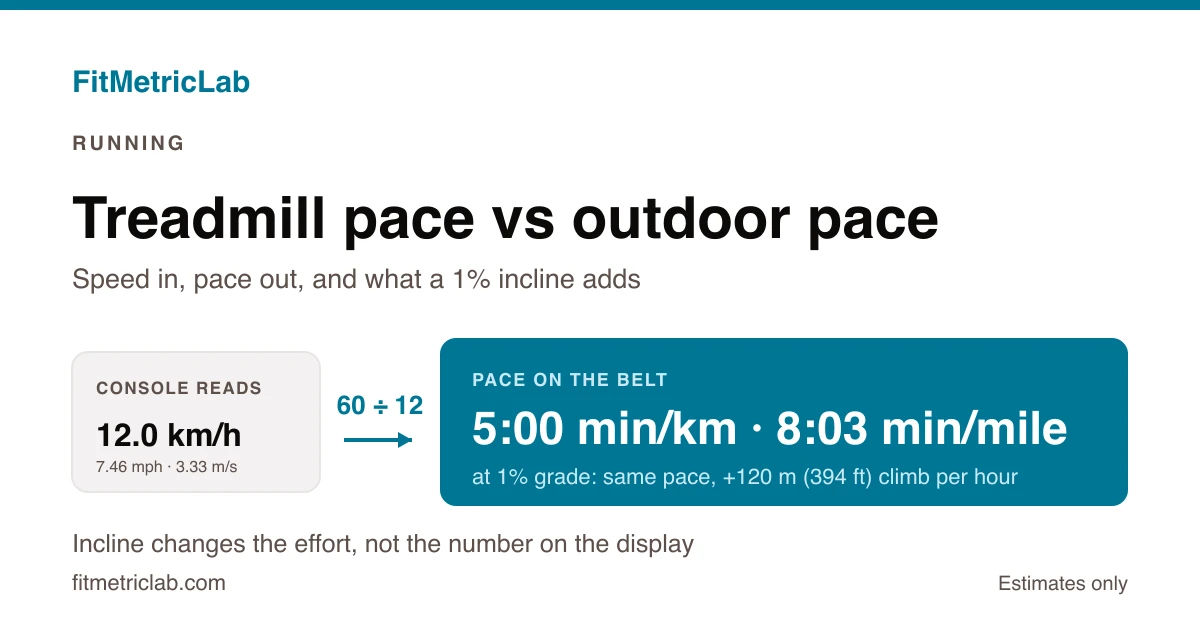
A treadmill console reading 12.0 km/h (7.46 mph) is, in arithmetic terms, a pace of exactly 5:00 min/km (8:03 min/mile). Whether holding that pace on a flat road costs more than holding it on the belt depends on the pace itself, because the air a runner pushes through outdoors matters more with every increase in speed. That relationship is what treadmill pace vs outdoor pace refers to, and the treadmill pace converter handles the arithmetic half of it: speed in, pace out.
What treadmill pace vs outdoor pace means
Treadmill pace is belt speed re-expressed as time per unit of distance. A belt moving at 12 km/h carries a runner one kilometre every five minutes, so the pace is 5:00 min/km, fixed by the motor whatever the runner does. Outdoor pace is the same quantity measured against the ground, usually by a watch. The two describe identical speeds, but the energy needed to hold them is not identical: indoors the air is still, so there is nothing to push through, while outdoors air resistance grows quickly with speed. The comparison is therefore two comparisons at once: a unit conversion, which is exact, and an effort comparison, which is an estimate.
Why the comparison matters
Training plans are written in pace and treadmills are set in speed, so a session at 5:00 min/km has to be translated into a console setting before it can be run. That conversion is the first reason the comparison matters.
The second is physiological. Pugh's measurements on a track and a treadmill showed that the oxygen cost of overcoming air resistance rises steeply with speed, reaching an estimated 8 per cent of the total at 21.5 km/h (13.4 mph), a 5000 m race pace, and 16 per cent in a 100 m sprint. The same displayed pace therefore represents a different workload depending on how fast it is. Incline is the usual lever for closing that gap, which is why the question so often arrives with the 1 per cent figure attached.
How treadmill pace is calculated
Speed is distance per unit of time and pace is time per unit of distance, so one is the reciprocal of the other: 60 divided by kilometres per hour gives minutes per kilometre, and 60 divided by miles per hour gives minutes per mile. Moving between the unit systems uses the mile's defined length of 1.609344 km, which is exact rather than measured. Metres per second, the unit the research is written in, is kilometres per hour divided by 3.6.
Incline does not enter the pace formula. What it adds is a vertical component: at a grade of one per cent, every kilometre of belt travel lifts the runner ten metres (33 ft).
pace_km   = 60 / speed_kmh
pace_mile = 60 / speed_mph

speed_kmh = speed_mph × 1.609344
speed_ms  = speed_kmh / 3.6

climb_per_hour = speed_kmh × grade × 10
The variables:
- speed_kmh = belt speed in kilometres per hour (mph × 1.609344)
- speed_mph = belt speed in miles per hour
- pace_km, pace_mile = the resulting pace in min/km (min/mile)
- speed_ms = belt speed in metres per second (× 2.237 for mph)
- grade = incline as a percentage, rise over run × 100, so 1 means 1 per cent
- climb_per_hour = vertical metres gained in an hour at that grade (× 3.281 for feet)
The 1 per cent figure comes from Jones and Doust, who measured oxygen uptake in nine trained runners during six-minute runs at six speeds from 2.92 to 5.0 m/s, or 10.5 to 18.0 km/h (6.5 to 11.2 mph), on a level road and on a treadmill at grades from 0 to 3 per cent. A 1 per cent grade was the one setting that matched the road at every speed tested.
At the two slowest speeds a flat treadmill matched the road as well. The flat belt fell measurably short of the road at the next three speeds, 3.75 to 4.58 m/s, which is 13.5 to 16.5 km/h (8.4 to 10.3 mph) or 4:27 down to 3:38 min/km (7:09 to 5:51 min/mile), while at the fastest speed the road sat between the 1 and 2 per cent belts without differing significantly from any grade. The correction belongs to faster running rather than to every speed.
A worked example
A treadmill shows 12.0 km/h (7.46 mph) with the deck at 1 per cent.
Step 1. Pace per kilometre. 60 ÷ 12.0 = 5.000 minutes per kilometre, which is 5:00 min/km.
Step 2. Speed in miles per hour. 12.0 ÷ 1.609344 = 7.4565 mph.
Step 3. Pace per mile. 60 ÷ 7.4565 = 8.0466 minutes per mile. The 0.0466 of a minute is 2.8 seconds, so the pace is 8:02.8, shown as 8:03 min/mile.
Step 4. Metres per second. 12.0 ÷ 3.6 = 3.333 m/s (7.46 mph). That is one of the six speeds Jones and Doust tested, and one of the two slowest, at which road running was not significantly different from the treadmill at either 0 or 1 per cent.
Step 5. What the incline adds. 12.0 × 1 × 10 = 120 m (394 ft) of climb per hour. The console still reads 5:00 min/km; the belt has not slowed. What has changed is that a 30-minute session covers 6.0 km (3.73 mi) of belt and 60 m (197 ft) of vertical. By the study's measurements that combination matches 6.0 km on a level road, and so, at this particular speed, does the flat belt: the grade only separated from 0 per cent between 13.5 and 16.5 km/h (8.4 and 10.3 mph).
How to use the Treadmill Pace Converter
The treadmill speed to pace converter takes two inputs: the number on the display and the unit it is in. Treadmills sold in the United States show miles per hour and machines almost everywhere else show kilometres per hour, and 10 on one display is a 6:00 mile while 10 on the other is a 6:00 kilometre, a 9:39 mile.
The headline result is the pace per mile, with the pace per kilometre, the speed in both units and the speed in metres per second beneath it. Nothing in the output changes with incline, because the converter models belt speed only. For the reverse job, turning an outdoor time and distance into a pace, the running pace calculator returns pace and speed in both unit systems.
Common scenarios
A plan in min/km on a treadmill marked in mph
The display reads 7.5 and the session says 5:00 min/km. 7.5 mph is 12.07 km/h, which converts to 4:58 min/km (8:00 min/mile), two seconds a kilometre quicker than the target. The pace converter (min/mile to min/km) handles the pace-to-pace side of the same problem when a training partner writes in miles.
Rehearsing a hilly course indoors
A hilly course cannot be reproduced by one grade, but its time cost can be estimated. A 10 km (6.21 mi) course with 150 m (492 ft) of gain at a 5:00 min/km flat pace carries a penalty of about 59 seconds under the common coaching heuristic of 12 seconds per mile per 100 ft of gain, roughly six seconds per kilometre. The elevation-adjusted pace calculator returns that adjusted figure, a concrete target for an indoor session.
Walking and hiking on an incline
The formula is the same at walking speed. A belt at 5.0 km/h (3.11 mph) is a 12:00 min/km (19:19 min/mile) pace, and at 10 per cent the walker gains 500 m (1,640 ft) an hour. Ten per cent is a 5.7 degree slope, and consoles marked in degrees are not interchangeable with those marked in per cent.
Common mistakes and misconceptions
- Reading the 1 per cent grade as a pace change. Tilting the deck does not alter the pace; 12 km/h is 5:00 min/km at any incline. The grade changes the energy cost of holding that pace, a quantity the console does not display.
- Applying the 1 per cent figure at every speed. The study behind it tested 10.5 to 18.0 km/h (6.5 to 11.2 mph). Outside that range the figure is an extrapolation rather than a result.
- Mixing the unit systems. A display in km/h read as mph produces paces off by a factor of 1.609. 10 km/h is 6:00 min/km, 10 mph is 6:00 min/mile, and a 6:00 mile is a 3:44 kilometre.
- Treating the console as a measurement. Belt speed depends on calibration, motor condition and belt wear. The displayed figure is a setting, and a treadmill pace that disagrees with a satellite watch does not settle which has drifted.
Frequently asked questions
Is treadmill pace vs outdoor pace the same at a 1 per cent incline?
The pace is the same at any incline, because pace describes the belt. What the 1 per cent grade was found to equalise is energy cost. Jones and Doust measured oxygen uptake in nine trained runners at 10.5 to 18.0 km/h (6.5 to 11.2 mph) and found that a 1 per cent treadmill grade most closely reflected the cost of road running. That is a statement about steady six-minute runs in a laboratory comparison, not about race times, terrain or weather, and at their two slowest speeds a flat treadmill matched the road as well.
How do I convert treadmill speed to pace?
Divide 60 by the speed. A display showing kilometres per hour gives minutes per kilometre: 10 km/h is 60 ÷ 10 = 6:00 min/km. A display showing miles per hour gives minutes per mile: 6 mph is 60 ÷ 6 = 10:00 min/mile. For the other unit, convert the speed first using 1.609344 km per mile, then divide again: 6 mph is 9.66 km/h, so 60 ÷ 9.66 = 6.21 minutes, which is 6:13 min/km. The decimal part of a minute becomes seconds by multiplying by 60, so 6.21 minutes is 6:13, not 6:21.
Why does running outside feel harder than the treadmill at the same pace?
Air resistance is the measurable part. Pugh found that the extra oxygen cost of running against wind rose with the square of the wind speed, and that in calm air on a track the cost of moving through it amounted to an estimated 8 per cent of the total at 21.5 km/h (13.4 mph), a 5000 m race pace, and 16 per cent in a 100 m sprint. At an easy jog the share is much smaller. On top of that sit surface, camber, wind and temperature, none of which the belt reproduces. The gap is not a fixed offset: it is larger at faster paces and on rougher routes, and close to zero at an easy pace on a calm day.
What incline on a treadmill equals running outside?
The published answer is 1 per cent, within the range of speeds it was tested at, and the arithmetic shows how modest that is. At 12 km/h (7.46 mph), a 1 per cent grade adds 120 m (394 ft) of climb per hour. Steeper settings are a different tool: 5 per cent at the same speed is 600 m (1,969 ft) an hour, which simulates a sustained hill rather than a flat road. Grade and degrees are different scales too: 1 per cent is 0.57 degrees, so a console marked in degrees set to 1 is steeper than the study's grade.
Sources and methodology
Every figure above was computed from the stated inputs and checked against the converter's output. Pace is 60 divided by speed, mile conversions use the exact 1.609344 km per mile, and metres per second is kilometres per hour divided by 3.6.
The physiology follows two peer-reviewed sources:
- Jones AM, Doust JH. A 1% treadmill grade most accurately reflects the energetic cost of outdoor running. Journal of Sports Sciences. 1996;14(4):321-327, the origin of the 1 per cent figure and of the 2.92 to 5.0 m/s speed range quoted here.
- Pugh LG. Oxygen intake in track and treadmill running with observations on the effect of air resistance. The Journal of Physiology. 1970;207(3):823-835, the source of the air-resistance estimates at 5000 m and sprint pace.
On wording: a gradient or running machine in the United Kingdom is an incline or treadmill in the United States, and both use per cent grade for the same rise-over-run figure. Displays read km/h almost everywhere and mph in the United States, where kilometre is spelt kilometer. Pace runs in min/km in metric markets and min/mile in the United States and the United Kingdom.
Putting it together
Treadmill pace vs outdoor pace splits into two questions with two kinds of answer. The unit question is exact: 60 divided by the belt speed gives the pace, and the treadmill pace converter returns the per-kilometre and per-mile figures without ambiguity. The effort question is an estimate. Air resistance makes a road pace cost more than the same belt pace, by a margin that grows with speed, and a 1 per cent grade was found to close that margin for trained runners between 10.5 and 18.0 km/h (6.5 and 11.2 mph). Outside that range the figure is a guide. Keeping the two questions separate is what makes the number on the console readable.
Last updated 17 September 2026.