What Is BMR? The Mifflin-St Jeor Formula Explained
Basal metabolic rate is the energy the body spends at complete rest. This post explains what BMR is, how the Mifflin-St Jeor equation estimates it from height, weight, age and sex, and how it differs from total daily energy expenditure.
JCVerified Verified by Jobi Cheriyan, Founder & Builder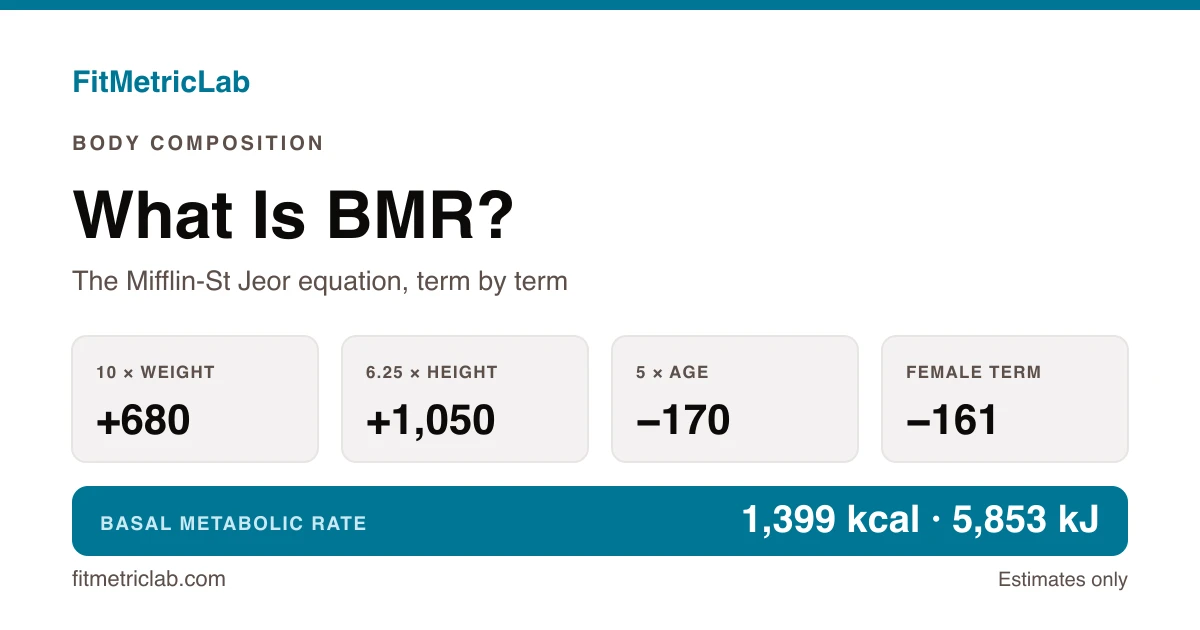
Lie still in a comfortable room, awake, twelve hours after the last meal, and the body carries on spending energy at a steady rate. For a 34-year-old woman of 68 kg (150 lb) and 168 cm (5 ft 6 in), that rate comes to about 1,399 kcal (5,853 kJ) across a full day, with nothing walked, lifted or digested. That number is her basal metabolic rate, and it is the plainest answer to the question of what is BMR: the cost of staying alive before anything else gets added on top.
The Mifflin-St Jeor equation estimates that cost from four inputs, namely height, weight, age and sex. What follows covers where the equation came from, the arithmetic line by line, and the fairly narrow thing the result actually describes. The BMR calculator (Mifflin-St Jeor) runs the same sums for anyone who would rather not do them by hand.
What is BMR?
Basal metabolic rate is the energy the body spends over 24 hours purely to keep itself running: heartbeat, breathing, brain activity, kidney filtration, immune function, cell turnover, and the constant low-grade work of holding internal temperature steady.
The laboratory definition is strict. The person is awake but motionless, in a room neither warm nor cool enough to provoke a response, roughly twelve hours after eating, with no exercise beforehand.
Nothing voluntary counts. Walking, digesting, fidgeting and training all sit outside the figure. It is reported in kilocalories per day, or in kilojoules where energy is expressed in SI units, and it forms the floor beneath every other energy number.
Why BMR matters
For people who are not highly active, basal metabolism is usually the largest single slice of daily energy use. The range most often cited is 60 to 70 per cent. Everything that gets discussed in gyms and on wearables, from training volume to step counts to the energy cost of digestion, is stacked on a base that was already there and that barely moves from one day to the next.
That makes it the sensible place to start when describing energy balance. A daily total with no resting figure underneath it is hard to read, because two people can arrive at the same total from very different mixes of resting metabolism and movement. Building upward from the base, and running the result through the TDEE calculator once the basal number exists, keeps both components visible instead of collapsing them into one.
How BMR is calculated
Mifflin and colleagues published the equation in 1990, after measuring resting energy expenditure by indirect calorimetry in 498 healthy adults aged 19 to 78, then fitting a regression to the results. Of that sample, 264 were of normal weight and 234 were obese by classification, which was rather the point: the older equations in use at the time had been built on leaner populations and tended to overshoot. The model explains about 71 per cent of the variation in resting expenditure, leaving nearly a third unaccounted for. The BMR formula it produced is deliberately plain: weight adds, height adds, age subtracts, and a constant at the end differs by sex.
Men:   BMR = (10 x weight) + (6.25 x height) - (5 x age) + 5
Women: BMR = (10 x weight) + (6.25 x height) - (5 x age) - 161
Where:
- BMR is basal metabolic rate in kilocalories per day (multiply by 4.184 for kJ/day)
- weight is total body mass in kilograms (1 kg is about 2.2 lb)
- height is standing height in centimetres (1 inch is 2.54 cm; 1 foot is 30.48 cm)
- age is age in whole years
- constant is +5 for men and -161 for women, applied once at the end
Basal or resting? The equation was fitted to resting metabolic rate measurements rather than to true basal readings taken under full overnight laboratory control. Resting values typically run around 10 per cent above true basal ones, because the person has usually been awake, upright and mobile before the measurement. Calculators, this one included, use the two labels interchangeably, and the gap is small next to the equation's own margin of error, but the output is closer to RMR than to a textbook BMR.
The input is total body mass. There is no term for body composition anywhere in the equation, which is the structural difference between it and the Katch-McArdle BMR calculator, where lean mass drives the result.
A worked example
The woman from the opening: 34 years old, 68 kg (150 lb), 168 cm (5 ft 6 in). Four steps, with rounding held back until the end.
- Weight term: 10 x 68 kg = 680
- Height term: 6.25 x 168 cm = 1,050
- Age term: 5 x 34 years = 170, subtracted
- Sex constant: 161 subtracted, since the female form applies
The first two terms come to 1,730. Taking off the age term leaves 1,560. Taking off the female constant gives a basal metabolic rate of 1,399 kcal per day, or 5,853 kJ.
The same height, weight and age run through the male form return 1,565 kcal, a difference of exactly 166 kcal, all of it from the constant. That gap is a population average standing in for average differences in lean tissue. It is not a measurement of either person.
One more step turns the basal figure into a daily total. At a moderate activity multiplier of 1.55, 1,399 kcal becomes roughly 2,168 kcal per day, which is the step the TDEE calculator handles. The multiplier is the crude link in the chain: shifting it by a single step moves the total far more than any rounding in the basal estimate ever could.
How to use the BMR Calculator (Mifflin-St Jeor)
The Mifflin-St Jeor BMR calculator applies the BMR formula above and asks for four things: sex, age in years, height and body mass. Height can be entered in centimetres or in feet and inches, and mass in kilograms, pounds, or stone and pounds. Conversion happens internally before the equation runs, so the units a reader already thinks in are the units they can type.
The output is a single figure in kilocalories per day, shown next to its kilojoule equivalent. Two things are worth holding in mind while reading it.
The first is that a regression line produced it, so a band of uncertainty surrounds the number on screen without ever appearing there. The Mifflin-St Jeor formula is a line of best fit, not a personal measurement. The second is that it describes rest only. That is why it will always look low beside whatever a fitness tracker reports for a full day.
Common scenarios
Comparing weekly totals as a distance runner
Someone logging 60 km (37 mi) a week sees large swings in daily expenditure, but the basal component hardly shifts between a rest day and a long run. Separating the fixed base from the variable training load is what makes the weekly pattern legible rather than noisy.
Carrying more lean mass than average
An equation built on total body mass cannot tell 68 kg of mostly lean tissue apart from 68 kg with a higher fat share, so both return the same estimate. Where a reliable body fat measurement exists, an equation keyed to fat-free mass tends to track the individual more closely, which is the reason composition-based alternatives exist alongside this one.
Checking an app figure against a named formula
Fitness apps frequently report an estimated resting rate without naming the equation behind it. Running identical inputs through a named formula gives a reference point, and shows how much of any discrepancy comes from the model rather than from the person.
Common mistakes and misconceptions
- Reading the output as measured. It is a prediction from a regression fitted to a sample, not a reading from a metabolic cart. Precision down to the last kilocalorie is an artefact of arithmetic rather than a sign of accuracy.
- Mixing units mid-calculation. Entering weight in pounds against a formula expecting kilograms inflates the weight term by roughly 2.2 times, and that error survives every step after it. Converting before the equation runs is what prevents it.
- Blurring BMR vs TDEE. The two differ by hundreds of kilocalories for anyone even moderately active, and substituting one for the other quietly corrupts everything downstream.
- Expecting equations to agree. For the example above, the revised Harris-Benedict equation (Roza and Shizgal, 1984) returns 1,450 kcal and Katch-McArdle at 25 per cent body fat returns 1,472 kcal, against 1,399 from Mifflin-St Jeor. A spread of that size between the Harris-Benedict BMR calculator and this one is ordinary, not a sign that one of them is broken.
| Equation | Drives the estimate | kcal/day | kJ/day |
|---|---|---|---|
| Mifflin-St Jeor (1990) | Total body mass, height, age, sex | 1,399 | 5,853 |
| Harris-Benedict, revised (1984) | Total body mass, height, age, sex | 1,450 | 6,067 |
| Katch-McArdle (25% body fat) | Fat-free mass only | 1,472 | 6,159 |
Frequently asked questions
What is BMR in simple terms?
BMR is the energy the body uses at complete rest to keep its basic systems running: heartbeat, breathing, brain activity, kidney filtration, cell repair and temperature regulation. The strict definition adds conditions, namely awake but lying still, in a thermally neutral room, around twelve hours after eating, with no exercise beforehand. Digesting, walking, fidgeting and training all fall outside it. For most people the figure represents somewhere around 60 to 70 per cent of total daily energy expenditure, which is why it forms the base layer of nearly every energy calculation. A prediction equation such as Mifflin-St Jeor estimates it from height, weight, age and sex rather than measuring it directly.
Is BMR the same as TDEE?
No. BMR is the resting floor; TDEE is the whole building. Total daily energy expenditure adds three components on top of the basal figure: the thermic effect of food, meaning the energy spent digesting and storing what gets eaten; exercise activity, meaning deliberate training; and non-exercise activity, which covers walking, standing, gesturing and general restlessness. TDEE is usually derived by multiplying BMR by an activity factor somewhere between about 1.2 and 1.9. In the worked example in this post, a basal figure of 1,399 kcal (5,853 kJ) becomes roughly 2,168 kcal at a moderate multiplier of 1.55. A TDEE calculator handles that second step.
How accurate is the Mifflin-St Jeor formula?
A widely cited 2005 systematic review found Mifflin-St Jeor landing within 10 per cent of measured resting energy expenditure for 82 per cent of non-obese adults and 70 per cent of obese adults, which is why it displaced older equations as the default. That still leaves real scatter: close to one person in five sits outside the band, and roughly one in three among obese adults. Thyroid function, body composition, medication, illness, ancestry and the measurement conditions on the day all push individuals away from the line. The equation was also derived from an adult sample, so it travels poorly to children, to athletes carrying unusual muscle mass, and to people at the extremes of body size. It works best as a starting estimate with error bars rather than as a fixed personal constant.
Does BMR change with age?
Yes, and the equation builds that in directly by subtracting five kilocalories for every year. Two people with identical height, weight and sex, one aged 34 and one aged 54, differ by 100 kcal (418 kJ) in the estimate. The underlying reason is mostly compositional: fat-free mass tends to decline across adulthood unless it is actively maintained, and fat-free tissue costs more to run than fat tissue does. Because the age term is a flat linear adjustment, it captures an average trend rather than any particular person's path, which is one reason composition-based equations sometimes track individuals more closely.
Sources and methodology
The form shown above is the rounded version in standard clinical and calculator use. The coefficients as published in 1990 were slightly different, at 9.99 for weight, 6.25 for height and 4.92 for age, with a sex term of 166 for men, all against a constant of -161.
For the worked example, the published coefficients give 1,401 kcal against 1,399 from the rounded form, a difference of about 2 kcal that is immaterial next to the equation's own error band. Every figure here was recalculated from the raw inputs rather than carried across from a secondary source. Conversions use 2.20462 lb per kilogram, 2.54 cm per inch and 4.184 kJ per kilocalorie.
- Mifflin MD and colleagues, a new predictive equation for resting energy expenditure in healthy individuals, American Journal of Clinical Nutrition, 1990
- Frankenfield D, Roth-Yousey L and Compher C, comparison of predictive equations for resting metabolic rate in healthy non-obese and obese adults, Journal of the American Dietetic Association, 2005
- Human energy requirements, report of a joint FAO, WHO and UNU expert consultation
Putting it together
The short answer to what is BMR is that it is the quiet majority of daily energy use, and Mifflin-St Jeor is a compact way to approximate it from four inputs anyone can supply. The worked example resolved to 1,399 kcal (5,853 kJ), a figure that becomes considerably more useful once its uncertainty band and its narrow definition are both kept in view. Two alternative equations returning 1,450 and 1,472 kcal from identical inputs make that point without further argument, and the BMR vs TDEE distinction is the one that trips readers up most often. The BMR calculator (Mifflin-St Jeor) removes the arithmetic, though the interpretation still belongs to the reader.
Last updated 23 July 2026.