Running Cadence: What the Numbers Mean
Cadence is steps divided by minutes, and the same run can read 168 or 84 depending on whether both feet were counted. A 45-minute run of 7,560 steps is worked through to 168 spm, a 106.7 cm step and 10.75 km/h, with the origin of the 180 figure alongside.
JCVerified Verified by Jobi Cheriyan, Founder & Builder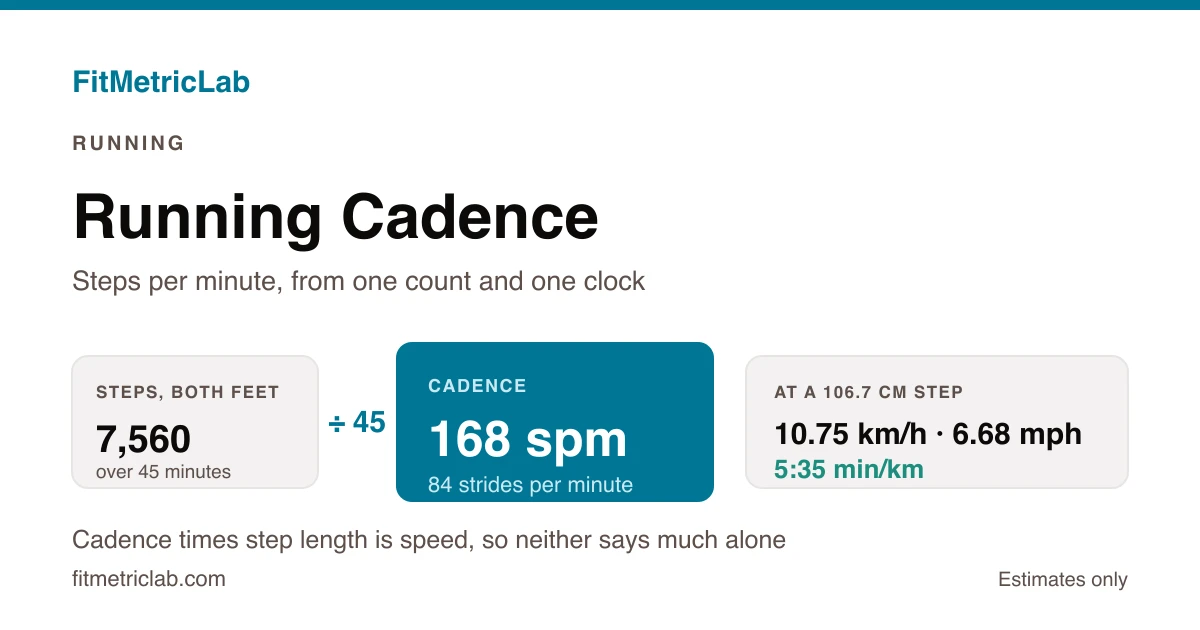
A watch reads 168 at the end of a steady 45-minute run. Open the same file in a different app and it says 84. Neither is wrong. So what is running cadence, if one run can carry two values for it? It is the number of steps taken per minute, and those two readings differ only in whether both feet were counted or one. The running cadence calculator returns the figure from a step total and a duration.
What is running cadence, in plain terms
Running cadence is the number of steps taken in one minute of running, written as steps per minute and shortened to spm. A step is a single footfall, left or right, so both feet count. Feet meeting the ground 168 times in a minute is a cadence of 168 spm, and the definition stops there. Step rate, step frequency and turnover are the same quantity under other names. Research papers often prefer stride frequency, which counts full gait cycles and so comes out at half the number. Cadence is a rate, as a heart rate is. It records how often something happens and is silent on how far each step travels or how fast the runner is moving.
Why running cadence matters
Speed is cadence multiplied by step length. Nothing else goes into it. Any change of pace is therefore a change in one, the other or both, which makes cadence half of a complete description of how a runner covers ground.
It is also the cheap half. A count and a clock are enough for cadence, where step length needs a trusted distance as well.
Laboratory work treats it as a variable in its own right. Heiderscheit and colleagues recorded 45 recreational runners on a treadmill at a constant speed while step rate was set 5 and 10 per cent above and below each runner's preferred value. Less mechanical energy was absorbed at the knee in both of the faster-stepping conditions, and at the hip only in the 10 per cent one. A systematic review of ten such studies found that a higher stride rate at the same speed went with less vertical movement of the centre of mass and a lower ground reaction force. One caution belongs beside both. These are measurements of mechanics at a fixed speed, not trials of an outcome, and every change in them is expressed against the runner's own starting point.
Terminology varies by region and by device. Metre and kilometre are the international spellings used here, meter and kilometer the American ones. Watches label the figure spm, steps/min or simply cadence.
How it is calculated
Divide the steps taken by the minutes they took. Two conversions sit beside that division, because counts arrive in different conventions, and one multiplication links the result to speed.
cadence_spm        = steps / minutes

steps              = single_foot_count * 2
strides_per_minute = cadence_spm / 2

speed_m_per_min = cadence_spm * step_length_m- steps: total footfalls over the period, both feet, a plain count.
- minutes: elapsed running time in minutes. Seconds are divided by 60 first, so 45 minutes 30 seconds is 45.5.
- cadence_spm: average steps per minute.
- single_foot_count: contacts of one foot only, the usual way to count by hand.
- strides_per_minute: gait cycles per minute, the convention some devices and many papers report.
- step_length_m: distance covered per step, in metres (1 m is 3.281 ft).
- speed_m_per_min: metres per minute (feet per minute). Multiply by 0.06 for km/h, then divide by 1.609344 for mph.
A worked example
Take a steady run of 45 minutes on which the watch logs 7,560 steps. Divide, and 7,560 by 45 is 168 spm. On the stride convention the same run is 168 divided by 2, or 84 strides per minute.
A hand count checks it. Thirty seconds of counting the right foot alone gives 42 contacts. Doubling for both feet makes 84 steps in half a minute, and 84 divided by 0.5 is 168.
Speed needs a distance. Suppose the route measures 8.064 km (5.01 miles). Step length is 8,064 m divided by 7,560 steps, which is 1.066667 m, or 106.7 cm (42.0 in). Cadence multiplied by step length is then 168 times 1.066667, giving 179.2 metres per minute (587.9 ft per minute). Multiplying by 0.06 gives 10.752 km/h, and dividing that by 1.609344 gives 6.681 mph, so the run averaged 10.75 km/h (6.68 mph).
Pace comes out of that same figure. One kilometre at 179.2 metres per minute takes 1,000 divided by 179.2, or 5.580357 minutes, which is 5:35 per kilometre (8:59 per mile). The running pace calculator returns the same 5:35 from 8.064 km and 45 minutes, with no step count involved: cadence and step length are a second route to a speed the distance and the clock already fixed.
Where the 180 figure came from
The number most often attached to running cadence is 180. Jack Daniels, a coach and exercise physiologist, counted the step rates of distance runners at the 1984 Olympic Games across events from 800 metres to the marathon. In his book Daniels' Running Formula he reports that almost every runner counted took 180 or more steps a minute.
Two details tend to go missing when the number is repeated. The runners were elite, racing at speeds far above an everyday run. And 180 was the bottom of what he saw: a floor for that group, not an average and not a target.
Speed matters here because cadence drifts upward with it, slowly. Cavanagh and Kram found stride frequency rising about four per cent across a range of speeds over which stride length rose twenty-eight per cent. The table shows what a given cadence demands of step length at two speeds, 10 km/h (6.21 mph) and 14 km/h (8.70 mph).
| Cadence | Step length at 10 km/h | Step length at 14 km/h |
|---|---|---|
| 150 spm | 111.1 cm (43.7 in) | 155.6 cm (61.2 in) |
| 160 spm | 104.2 cm (41.0 in) | 145.8 cm (57.4 in) |
| 170 spm | 98.0 cm (38.6 in) | 137.3 cm (54.0 in) |
| 180 spm | 92.6 cm (36.5 in) | 129.6 cm (51.0 in) |
| 190 spm | 87.7 cm (34.5 in) | 122.8 cm (48.3 in) |
At 10 km/h a cadence of 180 means a 92.6 cm step. At 14 km/h the same cadence goes with a 129.6 cm step. A cadence quoted without a speed is hard to interpret.
How to use the Running Cadence Calculator
The steps per minute calculator takes two inputs. Steps is the total number of foot strikes, both feet. Duration is the elapsed time in minutes, and the field moves in whole minutes. It opens on 5,100 steps and 30 minutes, which returns 170 spm.
The headline result is the cadence in steps per minute, rounded to a whole number. Beneath it the tool repeats the step total and the duration it used. Entering 7,560 steps and 45 minutes returns 168 spm. A short hand count goes in as its one-minute equivalent: 84 steps counted in 30 seconds is entered as 168 steps against 1 minute.
What comes back is a session average: the mean over everything inside the duration, standing time included, with no trace of how cadence moved within the run. And the Steps field means both feet, so a one-foot count is doubled before it is entered.
Common scenarios
A treadmill at a fixed belt speed
With the belt holding 10 km/h (6.21 mph), speed is pinned at 166.67 metres per minute (546.8 ft per minute), so cadence and step length trade against each other exactly. At 160 spm each step covers 104.2 cm (41.0 in). At 176 spm it covers 94.7 cm (37.3 in). The stride length calculator measures the length side directly from a distance and a step count.
Walking cadence
Nothing in the arithmetic is specific to running. A walk of 6,000 steps in 55 minutes is 109 steps per minute. Walking research uses the figure as a marker of intensity: the CADENCE-Adults study of 21 to 40 year olds set 100 steps per minute as a rounded rule-of-thumb threshold for moderate intensity and 130 for vigorous. Those thresholds describe walking and do not carry over to running.
Cycling cadence is a different unit
Cyclists measure cadence in revolutions per minute. One turn of the cranks includes a push from each leg, which makes rpm the counterpart of strides per minute, not steps. A rider at 90 rpm and a runner at 180 spm are moving their legs at the same rate.
The same pace at two cadences, in watts
The running power calculator estimates watts from body weight and pace alone. A 70 kg (154 lb) runner at 5:35 per kilometre, entered as 335 seconds per kilometre, is moving at 2.985 m/s, and 70 times 2.985 times 1.04 returns about 217 W. Cadence appears nowhere in that formula. The estimate is 217 W at 160 spm and at 176 spm alike.
Common mistakes and misconceptions
- Counting one foot and calling it steps. The commonest error and the largest, a factor of two. A reading of 84 and a reading of 168 can describe the same run, and neither looks wrong on the screen.
- Leaving pauses inside the duration. The 7,560 steps above took 45 minutes of running. If the clock kept going through three minutes at road crossings, the division becomes 7,560 by 48, which is 157.5 spm. Nothing about the running changed.
- Treating 180 as a universal target. It was the lowest value seen among elite runners in races, which is a different thing.
- Reading one session average as a fixed trait. Cadence shifts with speed, gradient and fatigue, so a single number from one run describes that run at that pace and little else.
Frequently asked questions
What is running cadence?
Running cadence is the number of steps taken per minute of running, counting both feet, and it is written in steps per minute or spm. It is found by dividing a step total by the minutes those steps took: 7,560 steps in 45 minutes is 168 spm. Stride frequency counts full gait cycles instead, so it comes out at exactly half, 84 in this case. Cadence is a rate and carries no distance in it. It describes how often the feet land, and it takes a step length alongside it before it says anything about speed.
Is 180 steps per minute the right cadence for every runner?
No single figure has been shown to suit everyone. The 180 number comes from the coach and physiologist Jack Daniels, who counted the step rates of distance runners racing at the 1984 Olympic Games and found that almost all of them took at least 180 steps a minute. That was an observation about elite athletes at race speed, and it described a floor for that group, not a target for others. Cadence also varies with speed and from one runner to the next, and recreational runners at easy paces are often measured well below 180.
Does running cadence change with speed?
It does, though by less than most people expect. Cavanagh and Kram measured male recreational distance runners across speeds from 3.15 to 4.12 m/s, roughly 5:17 to 4:03 per kilometre (8:31 to 6:31 per mile). Over that range stride frequency rose by about four per cent while stride length rose by twenty-eight per cent. Extra speed in that band came mostly from longer steps, with only a small contribution from quicker ones. A session average therefore depends on the pace it was recorded at.
Why does my watch show half the cadence I counted?
The device is almost certainly counting strides and the hand count steps. A stride is a full gait cycle, one foot's contact round to that same foot's next contact, and it contains two steps. A wrist or foot sensor that registers one side of the body sees 84 cycles a minute where a count of both feet gives 168. Doubling the lower number brings the two into line. The cadence calculator expects steps, so a one-foot tally is doubled before it goes in.
Sources and methodology
Cadence here is the arithmetic mean, steps divided by minutes, the definition used in the papers below. The account of the 1984 observations is taken from Daniels' Running Formula. Mile conversions use the exact international value of 1,609.344 metres.
- Heiderscheit BC, Chumanov ES, Michalski MP, Wille CM, Ryan MB (2011). Effects of step rate manipulation on joint mechanics during running. Medicine and Science in Sports and Exercise 43(2):296-302, for the step-rate conditions and joint energy findings.
- Schubert AG, Kempf J, Heiderscheit BC (2014). Influence of stride frequency and length on running mechanics: a systematic review. Sports Health 6(3):210-7, for the ten-study summary.
- Cavanagh PR, Kram R (1989). Stride length in distance running: velocity, body dimensions, and added mass effects. Medicine and Science in Sports and Exercise 21(4):467-79, for the four and twenty-eight per cent figures.
- Tudor-Locke C, Aguiar EJ, Han H, et al. (2019). Walking cadence (steps/min) and intensity in 21-40 year olds: CADENCE-adults. Int J Behav Nutr Phys Act 16(1):8, for the walking thresholds.
Putting it together
Running cadence is a count divided by a time. Both feet go into the count, only running time goes onto the clock, and what comes out is an average for that session at that pace. Halve it for strides per minute. Multiply it by a step length and it becomes a speed.
The famous 180 is a record of what elite racers were seen doing, and the studies that change cadence in a laboratory do so relative to each runner's own preferred rate. A figure from the cadence calculator for steps per minute is best read the same way: against the same runner's other sessions at a similar pace, with the speed and the counting convention noted beside it.
Last updated 5 October 2026.