Target Heart Rate: How to Find Your Training Range
A target heart rate is a percentage applied to a ceiling. On a 165 bpm maximum with a 60 bpm resting rate, moderate works out as 99 to 132 bpm by percentage of maximum and 102 to 122 by Karvonen, from the same person on the same day.
JCVerified Verified by Jobi Cheriyan, Founder & Builder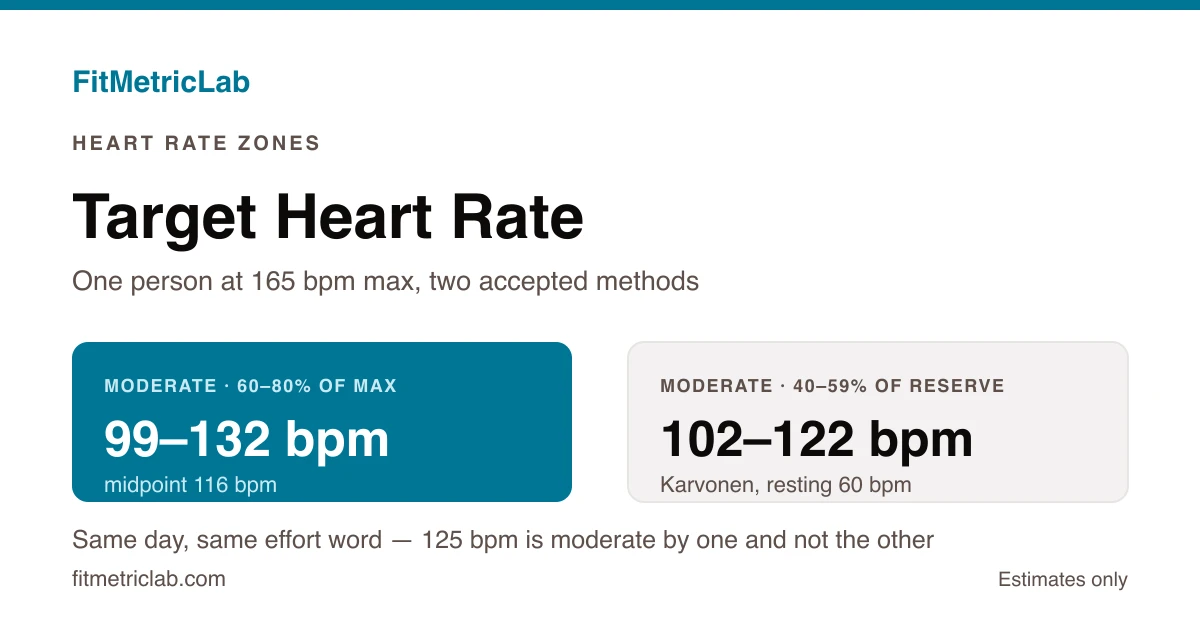
Someone with an estimated maximum of 165 beats per minute picks the moderate setting and gets 116 bpm, sitting inside a band of 99 to 132. The same person, same session, worked out by a different accepted method, gets 102 to 122. Asking what is target heart rate therefore has more than one defensible answer, and the gap between them is method rather than error. The target heart rate calculator returns the first of those; the difference is worth understanding before either number is read as a rule.
What is target heart rate?
Target heart rate is a count of beats per minute, or a range of them, corresponding to a chosen exercise intensity. It is derived rather than measured: a percentage is applied to a maximum heart rate, or to the span between resting and maximum, and the result is the rate the heart would be expected to show at that intensity. Because it descends from an estimated maximum in most cases, it inherits that estimate's uncertainty. What it describes is an intensity band, not a threshold dividing safe from unsafe or effective from ineffective.
Why a range beats a single beat count
Heart rate wanders for reasons unrelated to effort. Heat, dehydration, caffeine, sleep and altitude all move it by several beats at a constant workload. One figure alone implies a precision the measurement does not have.
A band absorbs that. Reporting 99 to 132 bpm rather than 116 acknowledges that the same effort can land anywhere across a span, and that the span itself came from an estimate. Behind these bands sit intensity categories drawn from exercise-science position statements rather than any one country's health service, so the scheme travels.
How a target heart rate is calculated
Two methods are in common use. Percentage of maximum multiplies a maximum heart rate by the chosen intensity. Heart-rate reserve, published by Karvonen and colleagues in 1957, works on the span between resting and maximum instead, then adds resting back.
Percentage of maximum   THR = MHR x i

Heart-rate reserve      HRR = MHR - RHR
(Karvonen)              THR = (HRR x i) + RHR
The variables:
- MHR (bpm) — maximum heart rate, measured in a graded test or estimated from an age equation
- RHR (bpm) — resting heart rate, counted at complete rest; used by Karvonen only
- HRR (bpm) — heart-rate reserve, the span from resting to maximum
- i (decimal fraction, or per cent) — the chosen intensity
- THR (bpm, beats per minute) — the result; the unit is the same worldwide, so no imperial conversion applies
The two methods do not use the same percentages for the same word. A band called moderate is 60 to 80% of maximum under the percentage method, and 40 to 59% of reserve under Karvonen. Reading a percentage from one scheme into the other is the single most common way these numbers go wrong.
A worked example
Take a maximum of 165 bpm, which is what 220 minus age returns for a 55-year-old, and a resting rate of 60 bpm. Percentage of maximum first, at the moderate setting:
165 x 0.60 = 99 bpm
165 x 0.80 = 132 bpm
midpoint    165 x 0.70 = 115.5, which rounds to 116 bpm
Now Karvonen, on the same two figures, using the 40 to 59% of reserve that defines moderate in that scheme:
HRR = 165 - 60 = 105 bpm
(105 x 0.40) + 60 = 102 bpm
(105 x 0.59) + 60 = 121.95, which rounds to 122 bpm
One person, one intensity word, two bands: 99 to 132 against 102 to 122. Reserve gives the narrower band, sitting higher at its floor, because it is anchored to this person's resting rate rather than to zero. Neither is wrong, and a session at 125 bpm counts as moderate by one method and vigorous by the other.
How to use the Target Heart Rate Calculator
The target heart rate range calculator takes two fields:
- Max HR (bpm) — a measured maximum, or one estimated from an age equation; accepted from 100 to 230
- Intensity — a choice of Light (50-60% MHR), Moderate (60-80% MHR) or Vigorous (80-90% MHR)
It asks for a maximum rather than an age, so that estimate has to come from somewhere first. A max heart rate calculator (220 minus age) is the quickest route to one, though an equation fitted to larger samples places the ceiling differently and moves every band below it.
Entering 165 with Moderate selected returns 116 bpm, labelled as the midpoint of the 60-80% band, with three lines underneath: the band at 99-132 bpm, the percentage used at 70.0% of MHR, and the maximum it came from. Reading the band rather than the midpoint is the more faithful use of it, since the midpoint carries no extra precision.
For the reserve method on the same figures, a heart rate zones (karvonen method) breakdown takes a resting rate as well, and a five-zone split of the same maximum is what a heart rate zones (% of max) view shows.
Common scenarios
Comparing a watch's zones with a calculated band
Devices rarely state which scheme they use. A watch calling a session moderate may be working from percentage of maximum, from reserve, or from a lactate-threshold estimate of its own. Where its band disagrees with a calculated one, the scheme is usually the reason rather than the sensor.
Cycling and swimming against running figures
Maximum heart rate tends to read lower in cycling than running, and lower again in swimming, because posture and the mass of working muscle differ. Bands built from a running maximum sit a few beats high when carried into either.
Someone with a low resting heart rate
Divergence is widest when resting rate is unusual. A trained endurance athlete with a resting rate of 40 bpm has a wider reserve than the same maximum would suggest, so Karvonen bands sit lower relative to percentage-of-maximum bands than they would for someone resting at 70.
Returning to exercise after a long gap
Heart rate at a given pace is usually higher after a layoff and falls as fitness returns, while the maximum stays where it was. A band calculated once stays fixed in beats while the effort needed to reach it changes.
Common mistakes and misconceptions
- Mixing percentages between the two methods. Sixty per cent of maximum and 60% of reserve are different numbers. On a 165 bpm maximum with a 60 bpm resting rate they are 99 and 123 bpm, a gap of twenty-four beats under one label.
- Treating the midpoint as the target. That single figure is the centre of a band, not a point to hold. The band is the output that carries meaning.
- Forgetting the uncertainty upstream. If the maximum was estimated from age, it may be ten to twenty beats from the individual's real ceiling, and every band below it shifts by the same proportion.
- Reading the bands as safety limits. Intensity categories describe effort, not risk. They were not drawn to mark a boundary beyond which exercise becomes unsafe for a given person.
- Comparing bands across sports without adjustment. A number derived from running applied unchanged to swimming is describing a maximum the swimmer does not reach in the water.
Frequently asked questions
What is target heart rate in simple terms?
It is the number of beats per minute, or the range of them, that corresponds to a chosen level of effort. That figure is calculated rather than measured: a percentage is applied either to a maximum heart rate or to the span between resting and maximum, and the answer describes what the heart would be expected to do at that intensity. Because the maximum behind it is usually itself an estimate from an age equation, a target band is an estimate built on an estimate. It describes an intensity category, and it is not a line separating safe effort from unsafe effort.
Which method is better, percentage of maximum or Karvonen?
Both are in standard use and neither is a measurement. Reserve accounts for an individual's resting heart rate, so it adapts to someone whose resting rate is unusually low or high, and its bands tend to sit higher at the floor. Percentage of maximum needs one input instead of two, which is why it appears more often in devices and charts. Since the intensity labels attach to different percentages in each scheme, the practical answer is that consistency matters more than the choice: comparing a Karvonen band with a percentage-of-maximum band will show a difference that is method, not progress.
Why is my heart rate above my target range at an easy effort?
Several ordinary things raise heart rate at a fixed workload: heat, humidity, dehydration, poor sleep, caffeine, illness and altitude among them. Rate also climbs through a long session at constant pace, which is known as cardiac drift. And if the maximum behind the band came from an age formula, the band may simply be set too low for that individual. A rate above a calculated range is as likely to mean the range was estimated imprecisely as to mean anything about the effort.
Do I need a chest strap, or is a wrist sensor enough?
Chest straps read the heart's electrical signal and track fast changes more closely. Optical wrist sensors infer rate from blood flow and can lag during intervals, lose the signal in cold conditions, or latch onto cadence and report the step rate instead. For steady efforts the two usually agree; for intervals the gap widens. Which device produced a number is worth knowing before comparing it with a calculated band, because a cadence artefact can look like a plausible heart rate.
Does a target heart rate change as fitness improves?
Not the band itself, which is calculated from a maximum that barely moves with training. What changes is the work needed to reach it: a pace that once sat at the top of a band may sit in the middle of it a few months later. Under the reserve method the band does shift slightly, since endurance training lowers resting heart rate and widens the reserve the percentages are applied to. Recalculating after a resting rate has clearly changed keeps the two in step.
Sources and methodology
The reserve method and its arithmetic come from the original Karvonen paper; the intensity categories and the percentages attached to them follow the American College of Sports Medicine's position stand, a scientific consensus document rather than any single country's health guidance. Worked figures were checked against the calculator's own engine, and only final beats-per-minute values are rounded.
- Karvonen MJ, Kentala E, Mustala O (1957). The effects of training on heart rate: a longitudinal study. Annales Medicinae Experimentalis et Biologiae Fenniae 35(3):307-15, the origin of the heart-rate reserve method.
- Garber CE, Blissmer B, Deschenes MR, et al. (2011). American College of Sports Medicine position stand: quantity and quality of exercise for developing and maintaining cardiorespiratory, musculoskeletal, and neuromotor fitness in apparently healthy adults. Medicine and Science in Sports and Exercise 43(7):1334-59, for the intensity classifications used by both methods.
- Tanaka H, Monahan KD, Seals DR (2001). Age-predicted maximal heart rate revisited. Journal of the American College of Cardiology 37(1):153-6, on the uncertainty carried by any age-estimated maximum.
Putting it together
A target heart rate is a percentage applied to a ceiling, expressed in beats per minute. Which ceiling, and which percentage, depends on the method: percentage of maximum multiplies the maximum directly, while the reserve method works on the span above resting and adds resting back. On a 165 bpm maximum with a 60 bpm resting rate, moderate comes out as 99 to 132 bpm one way and 102 to 122 the other, from the same person on the same day. Reading the band rather than its midpoint, and knowing which scheme produced it, is most of what the target heart rate zone calculator output is for.
Last updated 29 October 2026.