What Is TDEE and How to Calculate It
TDEE estimates the total energy a body uses in a day. This guide explains the two-stage calculation, works a full example in metric and imperial units, and shows exactly where the estimate stops being reliable.
JCVerified Verified by Jobi Cheriyan, Founder & Builder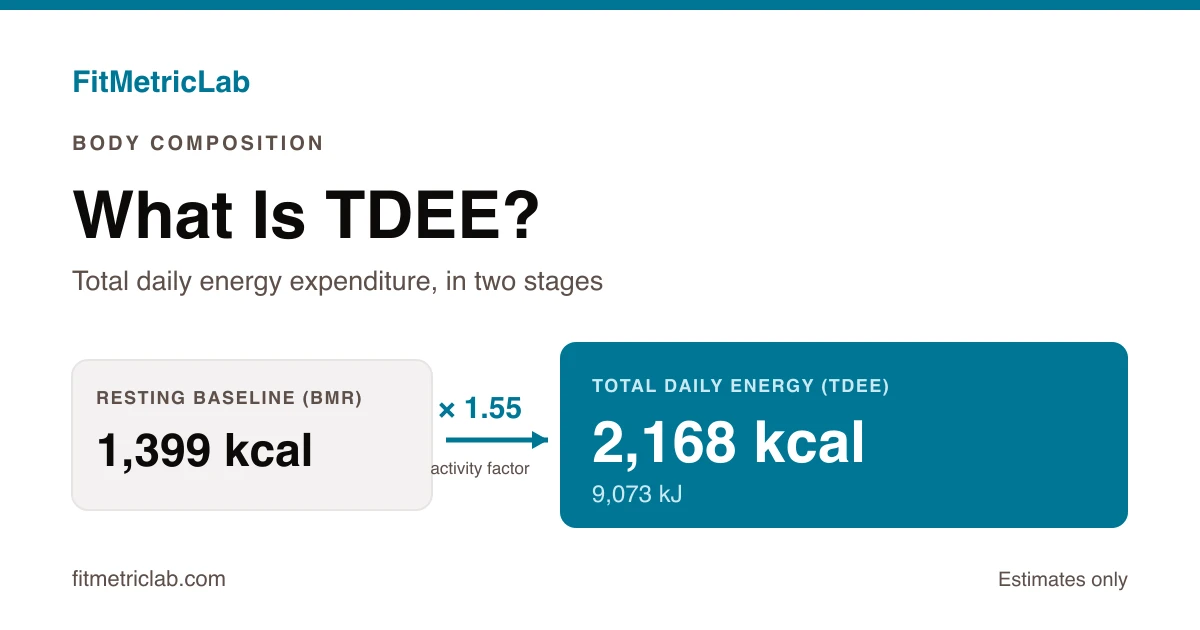
A 34-year-old woman who weighs 68 kg (150 lb) and stands 168 cm (5 ft 6 in) has an estimated resting energy expenditure of about 1,399 kcal (5,853 kJ) a day. Add a commute, four training sessions a week and everything else an ordinary day involves, and the estimate climbs to roughly 2,168 kcal (9,073 kJ). That second figure is her TDEE.
So what is TDEE, and why does one person produce two numbers 769 kcal apart? This guide covers the definition, the two-stage tdee formula, a worked example in metric and imperial units, and the part most articles skip: how much of the final number is worth trusting. The TDEE calculator handles the arithmetic in seconds, but the arithmetic was never the difficult part.
What is TDEE?
TDEE stands for total daily energy expenditure. It estimates all the energy a body uses across twenty-four hours. Most calculators report it in kilocalories, with kilojoules alongside, because food labels lead with kJ across Australia, New Zealand, the UK and much of Europe while the United States and Canada lead with calories.
Four things make up the total:
- Resting energy expenditure, the cost of simply staying alive: circulation, breathing, temperature regulation, cell repair. Commonly around 60% to 70% of the daily total for a moderately active adult.
- Thermic effect of food. The energy spent digesting and absorbing what you eat, usually put at roughly 10%.
- Exercise activity, deliberate training sessions.
- Non-exercise activity: walking, standing, carrying shopping, fidgeting. This one varies enormously between two people of identical size.
A calculator measures none of it. It estimates the resting portion from a published equation, then multiplies that figure by a single number meant to stand in for everything else. Two stages, and one of them is considerably shakier than the other.
One naming point before going further. Nearly every tool online, this one included, labels the first stage BMR, or basal metabolic rate. The equation behind it was published as a predictor of resting energy expenditure, which is measured under looser conditions and usually comes out a little higher than a true basal reading taken after an overnight fast in a darkened room. In a metabolic ward the difference matters. Outside one, the two terms get used interchangeably, and this post follows the common usage from here on.
Why the number matters
Energy expenditure is one of the few physiological figures that folds size, age and behaviour into a single number. Two people of identical body mass can sit several hundred kilocalories apart purely on how much they move. The same person can shift by that much between a heavy training block and a recovery week.
It also explains why comparing yourself to a training partner rarely goes anywhere useful. A taller frame carries a higher baseline before anyone moves at all, and a heavier body costs more to carry the same distance. The estimate makes those differences legible instead of mysterious.
There is a plainer reason the figure gets quoted so often: it is cheap. Indirect calorimetry measures expenditure directly by analysing inhaled and exhaled gas, but it needs laboratory equipment and someone trained to run it. An equation and a multiplier need four fields and about ten seconds. Accuracy gets traded for access, which is fine as long as the output is read with that trade in mind.
How to calculate TDEE
The tdee formula runs in two stages. First an equation estimates resting metabolic rate from height, body mass, age and sex. The Mifflin-St Jeor equation is the one most widely used in current dietetic practice, and it drives the Mifflin-St Jeor BMR calculator. Second, that baseline gets multiplied by an activity factor, conventionally somewhere between 1.2 and 1.9.
BMR (female) = (10 x mass) + (6.25 x height) - (5 x age) - 161
BMR (male)   = (10 x mass) + (6.25 x height) - (5 x age) + 5

TDEE = BMR x activity factor
Where:
- mass = body mass in kilograms, kg (lb)
- height = standing height in centimetres, cm (in)
- age = age in whole years
- BMR = estimated resting metabolic rate in kilocalories per day, kcal (kJ)
- activity factor = a unitless multiplier, conventionally 1.2 for sedentary, 1.375 lightly active, 1.55 moderately active, 1.725 very active, 1.9 for high training volumes
A small footnote on those coefficients. The 1990 paper used 9.99 for mass and 4.92 for age; the tidier 10 and 5 you see everywhere are rounded versions. For the example below, the rounding shifts the answer by about 2 kcal, which disappears entirely inside the error of the method.
The multipliers deserve a harder look than they usually get. They did not come from the same research as the equation. They are a convention inherited from older energy-requirement work and repeated across calculators ever since, which is why the same activity description can mean slightly different things on two different sites.
An older alternative, the Harris-Benedict equation from 1919, is still in circulation and available through the Harris-Benedict BMR calculator. It tends to return somewhat higher baselines than Mifflin-St Jeor for the same inputs.
A worked example
Back to the woman from the opening. She is 34, 68 kg (150 lb) and 168 cm (5 ft 6 in). A typical week for her holds four moderate training sessions around a mostly seated job, which maps to an activity factor of 1.55.
Term by term:
- 10 x 68 kg = 680
- 6.25 x 168 cm = 1,050
- 5 x 34 years = 170, subtracted
- 161 subtracted, the female constant
680 + 1,050 = 1,730. Take off 170 and you have 1,560. Take off 161 and the baseline is 1,399 kcal (5,853 kJ) per day.
Stage two is one multiplication: 1,399 x 1.55 = 2,168 kcal (9,073 kJ). That is the TDEE estimate, and the 769 kcal sitting between the two figures is the portion attributed to movement and digestion.
| Step | Running total (kcal) |
|---|---|
| 10 × 68 kg | 680 |
| + 6.25 × 168 cm | 1,730 |
| – 5 × 34 years | 1,560 |
| – 161 (female constant) | 1,399 (5,853 kJ) |
| × 1.55 (activity factor) | 2,168 (9,073 kJ) |
Now hold every physical input still and move only the activity factor. The same woman returns 1,924 kcal at 1.375 and 2,413 kcal at 1.725. One step either side of the band she picked, and the answer swings by 489 kcal. More than the entire error usually attributed to the equation itself. Nothing about her body changed. Only a dropdown did.
- Sedentary 1.2
- Lightly active 1.375
- Moderately active 1.55
- Very active 1.725
- High volume 1.9
| Activity band | Factor | TDEE estimate |
|---|---|---|
| Sedentary | 1.2 | 1,679 kcal (7,025 kJ) |
| Lightly active | 1.375 | 1,924 kcal (8,050 kJ) |
| Moderately active | 1.55 | 2,168 kcal (9,073 kJ) |
| Very active | 1.725 | 2,413 kcal (10,096 kJ) |
| High volume | 1.9 | 2,658 kcal (11,121 kJ) |
How accurate is a TDEE estimate?
The two stages fail differently, and it helps to know which is which.
Stage one is the better-behaved half. A systematic review published in the Journal of the American Dietetic Association in 2005 compared the four equations then most used in clinical practice against measured values. Mifflin-St Jeor landed within 10% of the measured figure more often than the others and carried the narrowest error range: about 82% of non-obese adults and about 70% of obese adults fell inside that band. Useful, clearly. It also means nearly one non-obese adult in five falls outside it, and closer to three in ten among obese adults, with no way of telling from the calculator alone which group any individual is in.
The same review flagged something worth carrying into any global reading of these numbers. Older adults and several ethnic groups were underrepresented both in the studies that built the equations and in the work validating them. The Mifflin-St Jeor sample was around 500 adults in the United States. Applying that to a 62-year-old in Manila or Lagos is an extrapolation, not a measurement, and the honest position is that nobody knows precisely how large the error gets.
Stage two is where most of the damage happens, though not for the reason usually given. Physical activity levels themselves have been studied properly. The FAO/WHO/UNU expert consultation on human energy requirements derived its ranges using doubly labelled water, the closest thing to a gold standard for measuring energy use in free-living people. What has never been validated is the step in between: converting a one-line description like "moderately active" into a number for a specific person. That is a self-assessment wearing the clothes of a measurement. Someone who trains four times a week but sits still the rest of the time and someone who never trains but is on their feet for nine hours can land on the same band and burn very different amounts.
Which points to the sensible way to read the output: as a range with a couple of hundred kilocalories of slack either side, checked against what actually happens to body mass over several weeks. Anyone whose observed weight trend disagrees with the calculator can take the observation as the better data.
How to use the TDEE calculator
The tdee calculator asks for four things: sex, age in years, height in centimetres or feet and inches, and body mass in kilograms or pounds. A fifth field picks the activity factor from a descriptive scale rather than asking for a bare number.
The output puts the estimated baseline and the estimated total side by side, in kilocalories with kilojoules alongside. Reading them together is what makes the result interpretable. The gap between the two is everything attributed to movement, and if that gap looks nothing like your week, the activity band is the field to revisit.
Once the figure exists it becomes an input elsewhere. The macro split calculator divides a daily energy figure into protein, fat and carbohydrate by percentage, taking the total as its starting value.
Common scenarios
A runner in a high-volume block
Someone covering 60 km (37 mi) a week sits near the top of the activity scale during that block and drops well down it during a taper. One annual figure describes neither phase. Recalculating at the start of each block tracks the change far more honestly than a single number carried through the year.
A desk-based worker who lifts three times a week
Three resistance sessions add less to weekly expenditure than most people assume, because lifting involves long rest intervals between short efforts. The bigger variable is usually non-exercise activity: whether the commute is walked or driven typically moves the weekly total more than the sessions themselves.
Activity that varies week to week
Shift patterns, seasonal work and travel produce weeks that look nothing like each other. Descriptive activity bands cope badly with this. Building the week up from individual activities through the custom activity MET calculator gets closer than picking one band and holding it all year.
An older athlete tracking change across decades
The age term subtracts five kilocalories per year, so a baseline drifts down by roughly 150 kcal (628 kJ) across three decades even with body mass unchanged. Training volume over the same period often holds steady or rises. The two effects pull in opposite directions, which is why a figure worked out in someone's thirties says very little about their fifties.
Common mistakes
- Treating the output as exact. Both stages carry meaningful uncertainty. Quoting the result to the nearest kilocalorie implies a precision the method has never had.
- Confusing BMR with TDEE. The baseline is the input; TDEE is the result. In the example above they sit 769 kcal apart, so swapping one for the other understates the total badly. A calculator that produces a figure without ever asking about activity is reporting the baseline, not the total.
- Mixing units. Entering pounds into a kilogram field inflates the answer by a factor of roughly 2.2, and entering inches where centimetres belong distorts it the other way. Kilojoules and kilocalories are just as easy to confuse when travelling between countries whose labels lead with different ones.
- Picking the activity factor aspirationally. The multiplier describes the week that happened, not the week that was planned. That 489 kcal gap between adjacent bands is where most of the error in a total daily energy expenditure estimate comes from.
- Never revisiting it. Body mass, age and activity all move. A figure calculated once and quoted for two years is describing a person who no longer exists.
Frequently asked questions
What is TDEE in simple terms?
The letters stand for total daily energy expenditure. Every kilocalorie a body spends in twenty-four hours, from staying alive at rest through to walking, training and digesting food. Calculators reach the figure in two steps: they estimate a resting baseline from height, weight, age and sex, then multiply it by a factor representing how active a typical week looks. The output usually carries kilojoules alongside kilocalories, because the two units split roughly along national lines on food labels and readers arrive from both conventions.
How accurate is a TDEE calculation?
Prediction equations are built from population averages, so they describe a group rather than a person. A 2005 systematic review found the Mifflin-St Jeor equation predicted resting metabolic rate within 10% of measured values in about 82% of non-obese adults and about 70% of obese adults, better than the other equations tested. Roughly one person in five falls outside that band. The activity multiplier adds considerably more uncertainty than the equation does: one step up or down that scale moves the result by several hundred kilocalories, which is why the same person can get very different figures from the same calculator on the same day.
What is the difference between BMR and TDEE?
Basal metabolic rate covers only the energy needed to run the body at rest: circulation, breathing, temperature regulation, cell repair. Total daily energy expenditure covers that baseline plus everything layered on top, including deliberate exercise, incidental movement and the energy cost of digesting food. BMR is always the smaller of the two and it is the input rather than the answer. In the worked example above the two sit 769 kcal apart, which is why the distinction is not academic.
How often does TDEE change?
The estimate shifts whenever an input shifts. Body mass moves most readily, and because the equation multiplies kilograms by ten, a change of five kilograms (11 lb) alters the baseline by roughly fifty kilocalories before any multiplier is applied. Age contributes a slow downward drift of about five kilocalories a year. Activity is the fastest-moving input of all: an injury, a change of job or a heavy training block can move the figure inside a single week with no change in body size at all.
Does the TDEE formula work the same for everyone?
Not equally well. The equations were developed and validated mainly on adults in North America and Europe, and the 2005 review noted that older adults and several ethnic groups were underrepresented in both the source studies and the validation work. Body composition is another gap: the formula uses total body mass rather than lean mass, so a heavily muscled athlete and a sedentary person of the same weight and height return the same baseline despite differing in reality. The estimate remains a reasonable starting point in most cases, and a measured weight trend over several weeks is better evidence than any equation.
Sources and methodology
Every figure above was calculated directly from the equation, with rounding applied only at the final step, and checked before publication. No number here is taken from a secondary summary or a third-party restatement. The accuracy figures come from the systematic review cited below rather than from any calculator site.
- Mifflin MD, St Jeor ST, Hill LA, Scott BJ, Daugherty SA, Koh YO: a new predictive equation for resting energy expenditure in healthy individuals, American Journal of Clinical Nutrition, 1990
- Frankenfield D, Roth-Yousey L, Compher C. Comparison of predictive equations for resting metabolic rate in healthy nonobese and obese adults, Journal of the American Dietetic Association, 2005
- American College of Sports Medicine, exercise physiology and energy expenditure guidance
- Compendium of Physical Activities: metabolic equivalent values by activity
Putting it together
So what is TDEE, in the end? A two-stage estimate. A published equation turns height, mass, age and sex into a resting baseline, and a multiplier scales that baseline to match how a week actually looks. The first stage has been tested against measured values and holds up reasonably for most adults.
The second stage rests on a self-assessment, which is why knowing how to calculate TDEE is mostly a matter of treating that multiplier with suspicion. One dropdown produced a 489 kcal swing in the example above without a gram of body mass changing. Putting the numbers through the total daily energy expenditure calculator, reading the output as a range, and checking it against what the scale does over a month turns a population average into something closer to a personal figure. Whichever units your local food labels happen to use.
Last updated 22 July 2026.