How Many Calories Does Lifting Weights Burn?
Weight training calorie burn comes from a MET value, body mass and working time. This guide works the formula through step by step, separates the gross figure from the net, explains why two well-sourced calculators can differ by 5%, and shows what the afterburn is actually worth.
JCVerified Verified by Jobi Cheriyan, Founder & Builder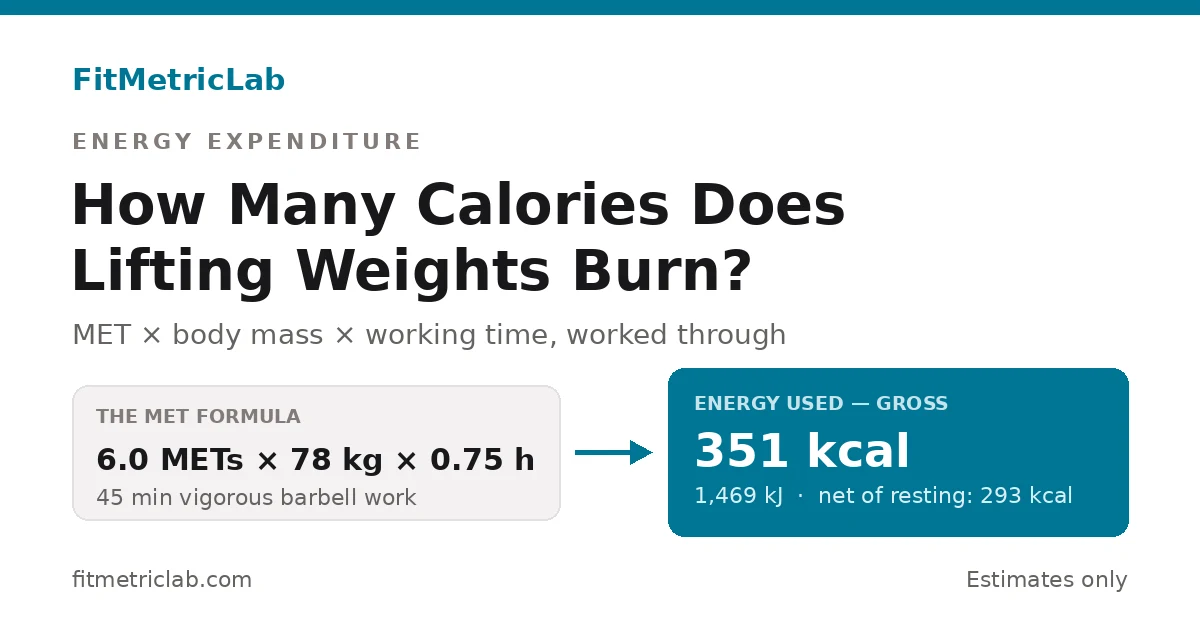
A 78 kg (172 lb) lifter who gets through 45 minutes of hard barbell work uses about 351 kcal (1,469 kJ). Take the same person, the same 45 minutes, and a comfortable set-and-chat rhythm instead, and the estimate drops to roughly 205 kcal. Same body, same clock, same room. A gap of nearly 150 kcal. That gap is the honest answer to how many calories does lifting weights burn, and it is why a single quoted number tells you almost nothing on its own.
What follows is the method behind every figure you will see quoted for resistance work: where the MET value comes from, how the arithmetic runs, and where it stops being reliable. The calories burned lifting weights calculator applies the identical formula, so each number here can be reproduced rather than taken on trust.
What the number actually measures
Calorie burn from weight training is an estimate of the energy your body uses across a session. It is reported in kilocalories (kcal) or kilojoules (kJ) depending on where you live. Labels across the EU, the UK, Ireland, Australia and New Zealand carry both. Labels in the United States and Canada print Calories with a capital C, which is the same quantity as one kilocalorie. One kcal is 4.184 kJ; nothing else in the maths changes between regions.
Three things drive the estimate: how heavy you are, how long you worked, and how hard the work was relative to sitting still. That last one is the metabolic equivalent of task, universally shortened to MET. One MET is the cost of quiet rest. An activity rated at 6.0 METs costs roughly six times that, for as long as it goes on.
Two details in that definition matter more than people expect. The word "roughly" is carrying real weight, because MET values are population averages measured in laboratories by indirect calorimetry and then compiled into the Compendium of Physical Activities. And the figure a calculator hands back is a gross total. It includes the energy you would have used anyway lying on the sofa for those same minutes. That distinction becomes important the moment anyone sets the number against food.
Why lifting is the awkward case
Continuous activities are kind to estimation. Heart rate tracks effort closely when the work is steady, so a watch has something reliable to model from. Lifting breaks that relationship completely. Heart rate spikes through a heavy set, sags across two minutes of rest, spikes again. Gripping a bar and loading the chest and arms during pressing work also interferes with wrist-worn optical sensors, which are reading blood flow through a limb you have just squeezed.
The result is that two devices can report figures for calories burned strength training in the same session that differ by a wide margin, with no way to tell which is closer. A method built on measured oxygen cost, body mass and time gives you something different: not more accuracy, but full transparency. Every input is visible and every input can be changed when the assumption behind it does not fit your session.
Session density is the other reason lifting resists a tidy answer. Two people can each spend an hour in a gym while one accumulates 40 minutes of working sets and the other manages 18. Duration alone cannot separate them, and the input the formula asks for is working time, not time on the premises.
How many calories does lifting weights burn: the calculation
The Compendium defines a MET as the ratio of an activity's energy cost to a standardised resting rate of 3.5 ml of oxygen per kilogram per minute, which it also expresses as approximately 1.0 kcal per kilogram of body mass per hour. That second form collapses the whole calculation into one line:
Energy (kcal) = MET × body mass (kg) × duration (hours)Where:
- MET = the intensity value for the style of training, unitless, read from a published table. Resistance work runs from 3.0 for general bodyweight movements to 9.8 for kettlebell swings.
- Body mass = in kilograms. From pounds, divide by 2.205; from stone, multiply by 6.35.
- Duration = working time in hours. Forty-five minutes is 0.75. Sets and the rest between them count; the walk from the car does not.
- Result = kilocalories. Multiply by 4.184 for kilojoules.
Two properties fall straight out of that line. Body mass enters in direct proportion, so a lifter 20 per cent heavier gets a figure 20 per cent higher for identical work, with no credit for technique or programme design. Duration behaves the same way: which leaves the MET value as the only input carrying any judgement at all, and therefore the only input worth arguing about.
MET values for resistance work
Every weight training MET value below comes from the 2024 Adult Compendium, the current edition, which replaced estimated values with measured ones wherever new data allowed. The style of training matters far more than the load on the bar.
- 3.0: bodyweight movements (squat, lunge, push-up, crunch), general
- 3.5: multiple exercises, 8 to 15 repetitions at varied resistance
- 5.0: squats or deadlifts, slow or explosive effort
- 5.8. Circuit work using reciprocal supersets or peripheral heart action training
- 6.0: power lifting or body building, vigorous effort; also circuit training built from bodyweight exercises
- 6.5. Bodyweight movements at high intensity
- 8.0: circuit training including kettlebells, some aerobic movement, minimal rest, vigorous
- 9.8. Kettlebell swings
Notice how narrow the middle of that range is. A gruelling heavy session and a brisk machine circuit sit within a couple of METs of each other, because the table is averaging across the rest periods as well as the sets. Perceived difficulty and metabolic cost are not the same quantity, and resistance training is where they diverge most sharply.
A worked example, step by step
Priya weighs 78 kg (172 lb) and lifts four evenings a week. Tonight's session holds 45 minutes of working time: compound barbell lifts at heavy loads, about 90 seconds of rest between sets. That description maps to power lifting or body building at vigorous effort, rated 6.0 METs.
Step 1. Convert the duration to hours. 45 ÷ 60 = 0.75 hours.
Step 2. Apply the formula. 6.0 × 78 × 0.75 = 351 kcal (1,469 kJ).
That is the gross figure, and it answers the question the way most people ask it. A second number is usually the more useful one. Across the same 45 minutes, resting metabolism at 1.0 MET accounts for 58.5 kcal. Energy Priya would have spent doing nothing at all. Strip it out and the training itself cost 293 kcal.
The net figure is the one that belongs in any comparison against food, because a daily energy target already counts resting metabolism on the other side of the ledger. Use the gross number in both places and roughly 59 kcal gets counted twice.
Change one input and the arithmetic moves immediately. Swap the long rests for a vigorous kettlebell circuit at 8.0 METs and the same 45 minutes returns 468 kcal. Keep the vigorous rating but log 30 minutes of honest working time instead of 45, and it falls to 234 kcal. Drop to a steady 8-to-15-repetition pattern at 3.5 METs and 45 minutes gives 205 kcal. Running those variants through the weight training calorie burn calculator takes seconds and makes the sensitivity of each input obvious.
Why two honest calculators disagree
Put the same session into two reputable tools and you may get 351 from one and 369 from the other. Neither is broken. They have taken different routes out of the same definition.
One MET can be expressed as 3.5 ml of oxygen per kilogram per minute, or as approximately 1 kcal per kilogram per hour. Those two statements are treated as equivalent, but they are not quite. Follow the oxygen route: 3.5 ml/kg/min for 60 minutes gives 210 ml/kg/h, which is 0.21 litres, and a litre of oxygen releases roughly 5 kcal across a mixed fuel mix, and you land at 1.05 kcal/kg/h. Five per cent above the rounder figure. Every calorie estimate built on the oxygen route sits 5 per cent above one built on the Compendium's own conversion, permanently and by construction.
Compendium route:  6.0 × 78 × 0.75            = 351 kcal
Oxygen route:      6.0 × 3.5 × 78 ÷ 200 × 45  = 369 kcal
FitMetricLab's tools use the Compendium route, so the figures throughout this article are the 351 kind. A watch, an app or a gym machine quoting 5 per cent more is not disagreeing with the science; it has picked the other equivalent.
MET tables move as well. The 2024 Compendium added 303 activities and adjusted 176 existing values: running at a 10-minute-mile pace, for instance, came down from 9.8 to 9.3 METs in that update, so an older tool still carrying the 2011 number returns about 5 per cent more for that pace. Between the conversion constant and the table edition, two well-sourced calculators can differ by a tenth without either doing anything wrong. The custom MET calculator lets you enter a value directly if you want to test what a different table does to your figure.
How to use the Calorie Burn: Weight Training tool
The tool asks for three things. Body mass takes kilograms, or pounds via the metric/imperial toggle. Duration takes working time in minutes, which for most people is meaningfully shorter than the clock time of the visit. Intensity is a three-way choice (light, moderate or vigorous) with the MET value each maps to (3.5, 5.0 and 6.0) shown beside it, so heavy compound lifting with long rests is simply Vigorous.
The output gives both the gross and net calorie burn. The session total in kilocalories with its kilojoule equivalent, the same figure with resting metabolism stripped out, and the rate per minute. Treat the net figure as the cost of the training and the gross figure as the answer to the question as usually asked.
Running the same session twice (once at the intensity that flatters it and once a level below) brackets the answer rather than producing a single false-precise number, which is closer to what the underlying data supports. Two related tools extend the picture: the activity calorie comparison calculator puts the same duration across different activities side by side, and the cycling calorie burn calculator covers the most common cardio pairing for a lifting programme.
Common scenarios
Four patterns cover most of what this calculation runs into. Each uses the same formula, changing only body mass, working time and the intensity rating.
General fitness at moderate effort
Tomas weighs 62 kg (137 lb) and does a machine-based full-body routine twice a week. Each session holds 40 minutes of working time at 8 to 15 repetitions per set with comfortable rest, which maps to 3.5 METs: 3.5 × 62 × (40 ÷ 60) gives 145 kcal (605 kJ). It sits well below what 40 minutes of effort feels like it should be worth, and that mismatch is the single most common source of disappointment with these figures.
A heavier lifter on a long session
Amara weighs 92 kg (203 lb) and trains a full hour of working time at vigorous effort. At 6.0 METs that comes to 552 kcal (2,310 kJ), about 18 per cent above a 78 kg (172 lb) lifter doing the identical session. The whole of that difference is body mass. Nothing about her technique, her programme or her strength enters the calculation.
A short, dense circuit
Dan weighs 70 kg (154 lb) and runs a 30-minute kettlebell circuit with rest held under 20 seconds between stations. Vigorous circuit training carries 8.0 METs, giving 280 kcal (1,172 kJ). In three-quarters of Tomas's working time he lands at nearly double the figure: rest density, not load, is doing that work.
Lifting against a cardio session
Priya wants to compare 30 minutes of lifting with 30 minutes on a bike. Stationary cycling at 126 to 150 watts is rated 8.0 METs and estimates 312 kcal, against 234 kcal for vigorous lifting: a gap of 78 kcal across the half hour. Thirty minutes of running at a 10-minute-mile pace would come to 363 kcal, and the full breakdown of running calorie burn works that side through in the same way. Energy cost is one axis of comparison and not the interesting one for most people who lift.
What the afterburn is worth
Oxygen consumption stays elevated after hard resistance work while the body restores oxygen stores, clears metabolites and begins repair. The effect is real, it has a name (excess post-exercise oxygen consumption, or EPOC), and it is routinely oversold.
The review literature puts EPOC at roughly 6 to 15 per cent of the net oxygen cost of the exercise itself, with the higher end reserved for heavy or supramaximal work. On Priya's 293 kcal net session that is somewhere between 18 and 44 kcal. Heavy compound lifting with short rests produces more of it than steady cardio at matched energy cost, which is a genuine point in favour of hard resistance work, but the numbers involved are a rounding error against the session, not a hidden second workout. MET-based estimates cover the training window only, so a calculator figure describes the work and nothing after it.
Common mistakes and misconceptions
- Reading an estimate as a measurement. MET values are averaged laboratory data, and an individual result 10 to 20 per cent either side of the estimate is entirely ordinary. The figure is a central expectation, not a reading off a meter.
- Entering clock time instead of working time. A 75-minute gym visit rarely holds 75 minutes of training. Counting the walk in, the phone, the queue for a rack and the conversation between sets can inflate the result by a third or more.
- Setting a gross figure against food intake. The gross total includes resting metabolism, which a daily energy target already counts. In the worked example above that double-counts about 59 kcal.
- Expecting the afterburn to close the gap. At 6 to 15 per cent of the session's net cost it adds tens of kilocalories, not hundreds.
- Mixing units without converting. Typing 172 into a field expecting kilograms returns a figure 2.2 times too high. And a label reading 1,469 kJ is the same energy as 351 kcal, not a different and larger number.
- Assuming heavier weights mean a bigger figure. Load barely enters the weight training MET value at all. Rest density and total working time move the estimate far more than what is on the bar.
Frequently asked questions
How many calories does lifting weights burn in an hour?
For a 78 kg (172 lb) lifter, an hour of steady work at 8 to 15 repetitions per set comes to about 273 kcal (1,142 kJ). An hour of vigorous barbell work rated 6.0 METs comes to about 468 kcal (1,958 kJ). The whole spread between those two is intensity, and body mass moves both figures in direct proportion. A 92 kg lifter adds roughly 18 per cent. Worth noting that very few sessions contain a solid hour of work: a 60-minute gym visit often holds 35 to 45 minutes once setup, rest and everything else is stripped out, so the honest input is usually smaller than the appointment in the diary.
Does lifting weights burn more calories than cardio?
Minute for minute, steady cardio usually returns the higher figure. For a 78 kg (172 lb) person over 30 minutes, vigorous lifting estimates 234 kcal, stationary cycling at 126 to 150 watts estimates 312 kcal, and running at a 10-minute-mile pace estimates 363 kcal. Lifting sits lower because the effort arrives in bursts and the MET value averages across the rest periods too. Dense circuit formats close much of that gap, reaching 8.0 METs. The two styles also build different things, so energy cost alone is a narrow basis for choosing between them.
Do you keep burning calories after a weights session?
Yes, though less than the popular framing suggests. Oxygen consumption stays raised while the body restores oxygen stores, clears metabolites and repairs tissue, an effect called excess post-exercise oxygen consumption. Review evidence puts it at roughly 6 to 15 per cent of the net oxygen cost of the session, so a 293 kcal training cost carries perhaps 18 to 44 kcal behind it. Heavy compound work with short rests sits at the higher end, and produces more afterburn than steady cardio matched for energy cost. MET-based calculators cover the training window only, so that figure is additional to whatever the tool reports.
Why do two people burn different amounts in the same session?
Body mass is the dominant factor and the only one the formula sees, which is why a 92 kg (203 lb) lifter estimates about 18 per cent above a 78 kg (172 lb) lifter doing identical work. Beyond that, training age cuts both ways: a practised lifter moves heavier loads but moves them more efficiently. Body composition, sex, hormonal factors, ambient temperature, sleep and how long the rest periods actually run all shift the true figure further. MET tables describe population averages, so an individual sitting 10 to 20 per cent either side of the estimate is unremarkable rather than a sign that something is wrong.
Sources and methodology
MET values come from the Compendium of Physical Activities, which catalogues measured oxygen cost across more than a thousand activities. The values used here are from the 2024 Adult Compendium: 6.0 for power lifting or body building at vigorous effort, 5.0 for squats and deadlifts, 3.5 for multiple exercises at 8 to 15 repetitions, and 8.0 for vigorous circuit training. The 2024 Adult Compendium paper in the Journal of Sport and Health Science documents that update, which added 303 activities and adjusted 176 existing MET values.
The conversion follows the Compendium's own definition of one MET as 3.5 ml of oxygen per kilogram per minute, or approximately 1.0 kcal per kilogram per hour. The alternative oxygen-uptake route and its metabolic equations are set out in ACSM's Guidelines for Exercise Testing and Prescription. Figures on post-exercise oxygen consumption come from LaForgia, Withers and Gore in the Journal of Sports Sciences, whose review places EPOC at 6 to 15 per cent of the net oxygen cost of exercise.
Every figure in this article was computed from MET × body mass (kg) × duration (hours) at full precision and rounded once, at the end. Imperial equivalents use 1 kg = 2.20462 lb and 1 stone = 6.35 kg; kilojoules use 1 kcal = 4.184 kJ.
Putting it together
The honest answer on calories burned lifting weights is a range rather than a figure. Resistance training costs less per minute than almost anyone expects, and the range across intensities is wide enough that a quoted number means nothing without the inputs beside it. For a 78 kg (172 lb) lifter, the same 45 minutes lands anywhere between 205 and 468 kcal depending on how the time was spent.
The patterns underneath are steadier than the number itself. Body mass scales the total in direct proportion, and working time (not gym time) is what the formula wants. Gross sits above net by the resting baseline.
Rest density moves the figure more than the load on the bar, which is the finding most lifters find counterintuitive. And the afterburn is worth tens of kilocalories rather than hundreds.
Run a session through the calorie burn calculator for weight training at two intensity assumptions and the range it produces is a fairer answer than any single figure. Which is the point: this is a reproducible estimate from three checkable inputs, and it does its best work as a comparison between sessions rather than a verdict on one.
Last updated 6 August 2026.