How Many Calories Does Walking Burn?
Walking calorie burn comes from a MET value, body mass and duration. This guide works the formula through step by step, shows why two well-sourced calculators can differ by 29% on the identical walk, and sets out where the estimate holds and where it drifts.
JCVerified Verified by Jobi Cheriyan, Founder & Builder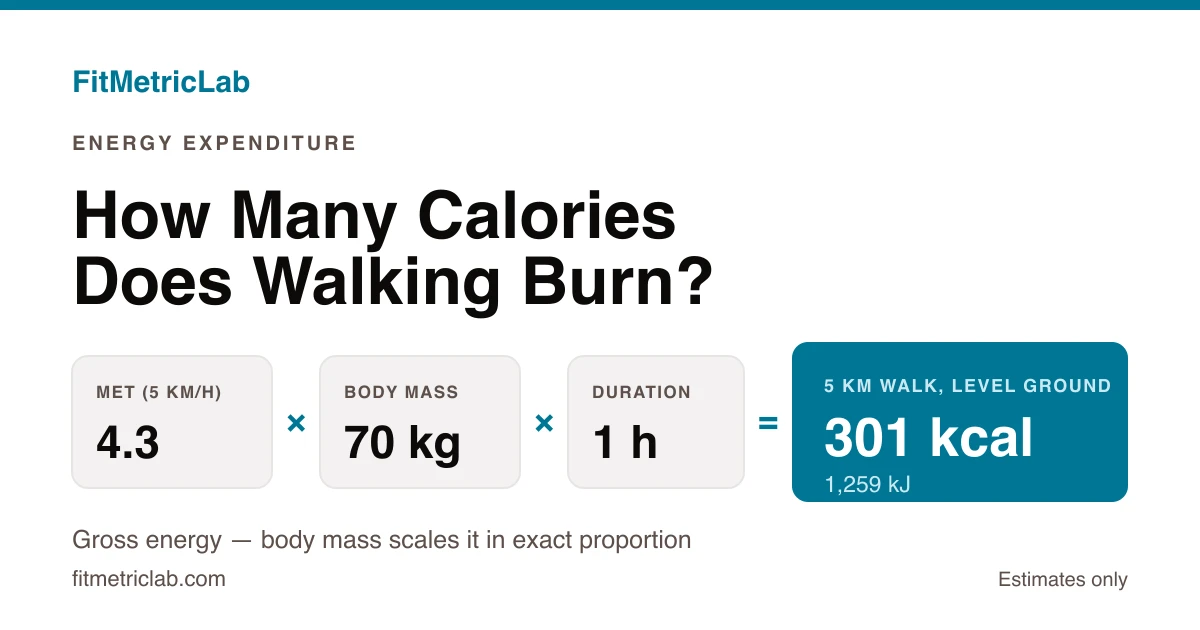
A 70 kg (154 lb, 11 st) walker covering 5 km at a steady 5 km/h. That is 3.1 mph, and it takes an hour: uses about 301 kcal (1,259 kJ). Keep the route, the pace and the shoes identical and change only the body mass to 90 kg (198 lb), and the same walk returns 387 kcal (1,619 kJ). Nothing about the walk changed. The walker did.
That gap is the whole answer to how many calories does walking burn, compressed. The number is not a property of the walk. It is a property of the walk and the person doing it, filtered through a lookup table built from laboratory averages. The walking calorie burn calculator runs the arithmetic in a second: what follows is where the arithmetic comes from, and how much weight it will bear.
What a walking calorie figure actually measures
It is an estimate of the total energy the body converts while walking, reported in kilocalories or kilojoules depending on where you live. Food labels across the EU, the UK, Ireland, Australia and New Zealand print both. Labels in the United States and Canada print Calories with a capital C, which is the same quantity as one kilocalorie. One kcal is 4.184 kJ. Nothing else in the maths changes between regions.
The estimate covers the whole body, not the legs. It is not a measurement of your body either. It is a measurement of other people's bodies, averaged, and then applied to yours.
That distinction matters more here than in almost any other fitness number, because walking is the activity people repeat most and scrutinise least. The Compendium of Physical Activities (the reference table underneath nearly every walking calculator in existence) is candid about the limits of its own data. Its documentation states that it was not built to determine the precise energy cost of an activity within an individual, and notes that it is routinely used that way anyway. A calorie figure for your walk is exactly that kind of use.
Why the number is worth estimating
If the figure cannot tell you what you personally used, what is it for? Comparison.
The MET system exists so that an hour of walking and forty minutes of cycling can sit on the same scale. That remains its best use. The absolute number carries real uncertainty; the ratio between two sessions calculated the same way carries far less, because identical assumptions and identical errors sit on both sides of the comparison.
Walking has a second claim on attention. It is the movement most people accumulate without deciding to (commutes, errands, stairs, corridors) which makes it the largest invisible component of the day for a lot of people. Putting a number on it makes an unplanned habit legible, and lets it be weighed against a planned session on equal terms.
None of that turns the figure into a target. It describes what a movement pattern typically costs in energy terms, and it stops there.
How walking calorie burn is calculated
FitMetricLab's tools use the Compendium's own conversion, which is about as simple as exercise physiology gets:
Energy (kcal) = MET × body mass (kg) × duration (hours)Where:
- MET, the intensity value for the pace, unitless, read from a published table. Level walking runs from about 2.0 at a stroll to 8.3 at a near-jog.
- Body mass. In kilogrammes. From pounds, divide by 2.205; from stone, multiply by 6.35.
- Duration: time actually walking, in hours. Thirty minutes is 0.5. If you only know the distance, divide it by the pace first.
The formula rests on one definition: one MET equals 1 kcal per kilogramme of body mass per hour. Sit quietly for an hour at 70 kg and you use roughly 70 kcal. Walk at 4.3 METs for that hour and you use roughly 4.3 times as much.
The walking MET value is the only input you cannot read off a watch, so it has to be assigned from pace. These are the 2011 Compendium's published level-ground values. The 2024 update revised several of them, which is one more reason two tools can disagree:
- Under 3.2 km/h (2.0 mph), strolling: 2.0 METs
- 3.2 km/h (2.0 mph), slow: 2.8 METs
- 4.0 km/h (2.5 mph): 3.0 METs
- 4.5 to 5.1 km/h (2.8 to 3.2 mph), moderate: 3.5 METs
- 5.6 km/h (3.5 mph), brisk: 4.3 METs
- 6.4 km/h (4.0 mph), very brisk: 5.0 METs
- 7.2 km/h (4.5 mph): 7.0 METs
- 8.0 km/h (5.0 mph): 8.3 METs
Two features of that table are worth noticing before trusting anything built on it. The values arrive in bands rather than along a curve, so a small pace change inside a band moves the estimate not at all, while crossing a boundary moves it in a step. And the step between 6.4 and 7.2 km/h is enormous: 5.0 to 7.0 METs for a difference of less than a kilometre an hour. That reflects a genuine physiological cliff, the point where walking stops being cheaper than running, but it makes the top of the table jumpy.
FitMetricLab's own calculator groups those rows into four broader bands: 2.5 METs below 3.2 km/h, 3.3 up to 4.8 km/h, 4.3 up to 6.4 km/h, and 5.5 above that, and reports the value it used next to the result. The two agree at the paces most walking actually happens at, including the 5 km/h worked through below. They part company at the top of the range, where the Compendium's separate 7.0 and 8.3 MET rows sit above the calculator's ceiling: where this article quotes a published row the calculator does not reproduce, it says so.
A worked example, step by step
Take a 70 kg (154 lb) walker covering 5 km on level ground at a steady 5 km/h. Both the Compendium and the calculator rate that pace at 4.3 METs.
- Convert distance to duration. 5 km ÷ 5 km/h = 1 hour.
- Convert duration to hours. One hour is 1.0. No arithmetic needed here, which is why this example was chosen.
- Multiply the three terms. 4.3 × 70 × 1.0 = 301 kcal.
- Round once, at the end. 301 kcal, or 1,259 kJ.
For the net figure, run the same sum at 1 MET: 1 × 70 × 1.0 = 70 kcal of resting baseline. Take that off and 231 kcal (967 kJ) remains as the energy attributable to the walking itself. Net sits 23% below gross here, which is roughly what to expect for level walking at any moderate pace.
Broken down, the calories burned walking per km work out at 301 ÷ 5 = 60.2 kcal (252 kJ), or about 97 kcal (405 kJ) per mile. Per minute it is 5.0 kcal: a useful anchor, because a 70 kg runner at 10 km/h sits at 11.4 kcal per minute, well over twice as much. The walking calorie burn estimator reports the session total, from which the per-kilometre and per-minute figures follow directly.
Why two honest walking calculators disagree
Search the same question on three sites and you will get three answers for the identical walk. Most of the spread is not error. It comes from two documented choices, and walking is unusually exposed to both.
The first choice is which walking MET value applies. The Compendium rates 2.8 to 3.2 mph level walking at 3.5 METs, and 3.5 mph brisk walking at 4.3. A pace of 5 km/h is 3.1 mph, which sits at the top of the lower band while feeling brisk to most people. Build on 3.5 METs and our 70 kg hour returns 245 kcal. Build on 4.3 and it returns 301. Same walk, same formula, 23% apart, both values printed in the same reference table.
The second choice is which definition of a MET you follow. The Compendium gives two, on the same page. One MET is 1 kcal per kilogramme per hour. One MET is also an oxygen uptake of 3.5 millilitres per kilogramme per minute. Follow the oxygen route: 3.5 ml/kg/min is 0.21 litres per kilogramme per hour, and each litre of oxygen releases about 5 kcal, and you land on 1.05 kcal/kg/h, not 1.00. Any calculator built on the oxygen definition returns figures exactly 5% higher than one built on the kilocalorie definition, from identical inputs, with neither of them wrong. That is the MET × 3.5 × kg ÷ 200 × minutes formula you will see on other sites; it is the same method wearing different clothes, and it returns 316 kcal for our walk.
Stack the two choices and the defensible range for a 70 kg walker doing 5 km at 5 km/h runs from about 245 to about 316 kcal: a 29% spread, every value in it traceable to a published source. Add the gross-versus-net question and the low end drops to 175.
Which is why the sensible way to read 301 kcal is "around 300", and why comparing two walks from the same calculator is far more informative than comparing one walk across two apps.
Turning steps into calories
Step counts are the most common way people meet this question, and they add a third source of uncertainty before the formula even starts. A step total has to become a distance, and that conversion runs on stride length.
At a 0.75 m (2.46 ft) stride, 5 km comes to roughly 6,670 steps, which puts our worked example at about 45 kcal (189 kJ) per 1,000 steps. Push the same 10,000-step benchmark through: 10,000 steps at that stride covers 7.5 km (4.66 mi), which at 5 km/h takes 90 minutes and returns 452 kcal (1,889 kJ) for a 70 kg walker.
Change the stride to 0.65 m and those 10,000 steps cover 6.5 km instead, and the estimate falls by around 13% with nothing else altered. Stride varies with height, leg length, pace and terrain, and most wearables infer it from a height field rather than measuring it. Two people with identical step counts and identical body mass can legitimately see different totals for that reason alone.
How to use the walking calorie tool
The calories burned walking calculator takes body mass, walking duration and pace, applies the MET value matched to that pace, and returns a gross figure in kilocalories. There is a metric and imperial toggle, so pounds and miles per hour work as readily as kilogrammes and kilometres per hour, and the MET value it used is printed beside the result.
Two things worth knowing before reading the output. Duration is time actually walking: stopping to wait at a crossing or read a sign does not count, and over a long errand-heavy walk that gap can run to a fifth of the elapsed time. And because MET values sit in bands, small pace differences inside a band will not move the result at all.
Some walks fall outside the standard bands altogether: a loaded pack, sand, snow, a steep trail, or any pace above 6.4 km/h where the Compendium's rows climb past the calculator's top band. For those, the custom activity MET calculator takes a MET value directly, which lets you use a specific Compendium code instead of the nearest level-ground approximation. To place a walk against other sessions on one scale, the activity calorie comparison calculator runs several at once.
How many calories does walking burn in common situations?
The commute walk, split in two
Fifteen minutes each side of a working day is 30 minutes in total. At a very brisk 6.4 km/h (4.0 mph) the calculator applies 5.5 METs, giving a 70 kg walker 193 kcal (805 kJ) gross, or 158 kcal net. The Compendium's own row for that pace is 5.0 METs, which would return 175 kcal. The same walk, 10% apart, for exactly the reason set out earlier. Splitting a walk into segments changes nothing at all, because the formula is linear in time: two fifteens and one thirty return the same number.
Same 30 minutes, different pace
Hold the clock still at 30 minutes and 70 kg. A moderate 5 km/h returns 151 kcal (630 kJ). A very brisk 6.4 km/h crosses into the calculator's top band and returns 193 kcal. Past that the calculator holds at 5.5 METs, while the Compendium keeps climbing: its 7.2 km/h row is 7.0 METs, or 245 kcal for the same half hour, a 40% jump over its own 6.4 km/h figure for a pace rise of 0.8 km/h. That cliff is real physiology (it is where walking stops being cheaper than running), and it is the clearest case of a published row the calculator's broader bands do not follow. Above 6.4 km/h, enter the Compendium value into the custom MET tool instead.
Walking as recovery around harder training
Easy walking on non-session days costs little per minute and accumulates quietly. Running at 10 km/h returns 11.4 kcal per minute for a 70 kg athlete against 5.0 for walking at 5 km/h, but over a fixed distance the two converge sharply, because walking a route simply takes longer. The running calorie burn breakdown works the same formula through on the running side, and the calorie burn running calculator puts both on one basis.
Treadmill console against tool estimate
A treadmill applies a manufacturer's own equation, often with a default body mass when none is entered, and frequently reports gross where a watch reports net. A console figure and a MET-based estimate for the same session will not usually match, and the size of the gap is set by which assumptions each one made rather than by which is closer to the truth.
What hills do to the number
Every figure above assumes level ground, and level-ground tables understate hill walking badly. This is not a rounding issue.
The Compendium carries separate gradient entries and the numbers are stark. Walking at 4.7 to 5.6 km/h on a 1% to 5% grade rates 5.3 METs, against 4.3 on the flat: 23% more energy for the same speed on the clock. On a 6% to 15% grade the same pace rates 8.0 METs, which is 86% above the level figure and higher than jogging on flat ground. For a 70 kg walker across 30 minutes that is 151 kcal on the flat, 186 kcal on a gentle rise and 280 kcal on a sustained climb.
Descending does not give it back. Downhill walking costs less than level walking down to a gradient of roughly −10% to −20%, then rises again on steeper slopes as braking work takes over. Because the uphill cost climbs far more steeply than the downhill cost falls, a loop with equal ascent and descent lands above the flat-ground estimate rather than averaging back to it.
Any tool that applies one flat MET value to all walking misses this entirely: including the walking calculator here, which takes no gradient input. For graded walking, read the Compendium row for your slope and enter it in the custom activity MET calculator, which is what that tool is for.
Common mistakes and misconceptions
- Treating an estimate as a measurement. Indirect calorimetry measures energy expenditure. A MET table estimates it, using an average drawn from people who are not you. A 10% to 20% spread around any published figure is ordinary.
- Comparing a gross figure against a net one. One tool reporting 301 kcal and another reporting 231 kcal for the same walk are often running the same formula under different conventions. Checking which is displayed resolves most apparent disagreements before anything else needs investigating.
- Mixing units mid-calculation. Entering 154 into a field expecting kilogrammes inflates the result by a factor of 2.2. Scales report kilogrammes, pounds or stone depending on the country, and the field label deserves a second look.
- Assuming steps convert cleanly to distance. Stride length varies with height, pace and terrain, and a device that infers stride rather than measuring it carries that error into every daily total.
- Reading a level-ground figure on a hilly route. The largest single error most walkers make with these tools, and the one with the biggest consequence.
- Confusing energy expenditure with body composition change. The formula describes the energy cost of movement over a period. It says nothing about what subsequently happens to body mass, which depends on a great deal more than one walk.
Frequently asked questions
How many calories does walking burn per kilometre?
For a 70 kg (154 lb) walker at a steady 5 km/h, the calories burned walking per km come to about 60 kcal (252 kJ), or roughly 97 kcal (405 kJ) per mile. The figure scales in direct proportion to body mass, so a 90 kg (198 lb) walker covering the same ground lands near 77 kcal per kilometre and a 55 kg (121 lb) walker near 47. Pace matters less per kilometre than most people expect, because a faster pace raises the cost per minute while cutting the minutes spent walking. The per-kilometre figure is gross: it includes the resting energy the body would have used during that period regardless.
How many calories does walking 10,000 steps burn?
Step totals have to become a distance before any energy figure exists, and that conversion depends on stride length. At a 0.75 m (2.46 ft) stride, 10,000 steps covers 7.5 km (4.66 mi). A 70 kg (154 lb) walker covering that at 5 km/h takes 90 minutes and gets about 452 kcal (1,889 kJ) gross. Drop the stride to 0.65 m and the same step count covers 6.5 km, cutting the estimate by around 13%. This is why two people with identical step totals often see different numbers, and why a wearable that infers stride from a height field rather than measuring it carries that uncertainty into every daily figure it reports.
Is walking or running better for burning calories?
Per minute, running returns well over double: 11.4 kcal against 5.0 for a 70 kg person comparing 10 km/h running with 5 km/h walking. Per kilometre the gap narrows a long way, because moving a given body mass a given distance costs broadly similar energy either way, and walking simply takes longer to cover the ground. Which comparison is the relevant one depends entirely on whether time or distance is being held constant, and that is worth settling before reading either number. Terrain, gradient and how long each activity can actually be sustained all shift the answer further.
Why do walking calorie estimates differ between apps and devices?
Small assumption changes move the output a long way. Some tools return gross energy and some return net, a difference of about 23% for level walking. Some assign a single MET value to all walking while others vary it by pace and gradient, and the Compendium itself lists both 3.5 and 4.3 METs for paces near 5 km/h. Some build on the kilocalorie definition of a MET and some on the oxygen definition, which are 5% apart by construction. Stride length adds another layer to anything derived from steps. Heart rate models add a further one, since heart rate responds to heat, caffeine, hydration and stress as well as to workload.
Sources and methodology
MET values and the kilocalorie conversion come from the Compendium of Physical Activities, which catalogues measured oxygen cost across more than a thousand activities and publishes the level-ground and graded walking tables quoted here. The peer-reviewed 2024 Adult Compendium paper in the Journal of Sport and Health Science documents the most recent update, in which the majority of listed activities now carry measured rather than estimated values.
The discussion of individual variation draws on the Compendium's corrected METs documentation, which sets out both the case for adjusting the standard 3.5 ml/kg/min baseline using measured resting metabolic rate and the objections to doing so. Activity intensity categories follow the World Health Organization guidelines on physical activity and sedentary behaviour. The gross and net conventions follow the metabolic calculations published by the American College of Sports Medicine in its Guidelines for Exercise Testing and Prescription.
The calculator applies MET × body mass (kg) × duration (hours), assigning the MET value from pace across four bands: 2.5 below 3.2 km/h, 3.3 up to 4.8 km/h, 4.3 up to 6.4 km/h, and 5.5 above that. Figures in this article attributed to the calculator use those bands; figures attributed to the Compendium use its published rows, which are quoted in full above. Every number was computed at full precision and rounded once, at the end.
Putting it together
Walking energy expenditure comes down to four inputs. Body mass and time set the size of the number; pace and gradient enter through the MET value. The 301 kcal in the worked example is not a fact about a walker. It is what this method returns for a 70 kg body covering 5 km at a steady pace on level ground.
The patterns underneath outlast the number. Body mass scales the total in exact proportion. Distance drives it more than speed does. Gross sits above net by the resting baseline. Uphill cost rises far more steeply than downhill cost falls, so hilly routes land above the flat estimate rather than averaging out.
Two estimates that disagree can nearly always be reconciled by checking three things: gross against net, the MET value applied, and the units entered. The walking calories burned calculator prints the MET value and pace it used beside the result and labels its units, which is what makes the figure auditable rather than merely plausible. It reports gross energy; for net, subtract 1 MET × body mass × hours.
Last updated 3 August 2026.