How to Calculate Running Pace
Running pace is time divided by distance, but the seconds conversion and the exact mile factor are where hand calculations go wrong. A 10 km run in 52:30 is worked through to 5:15 min/km, 8:27 min/mile and 11.43 km/h, with each figure cross-checked by a second route.
JCVerified Verified by Jobi Cheriyan, Founder & Builder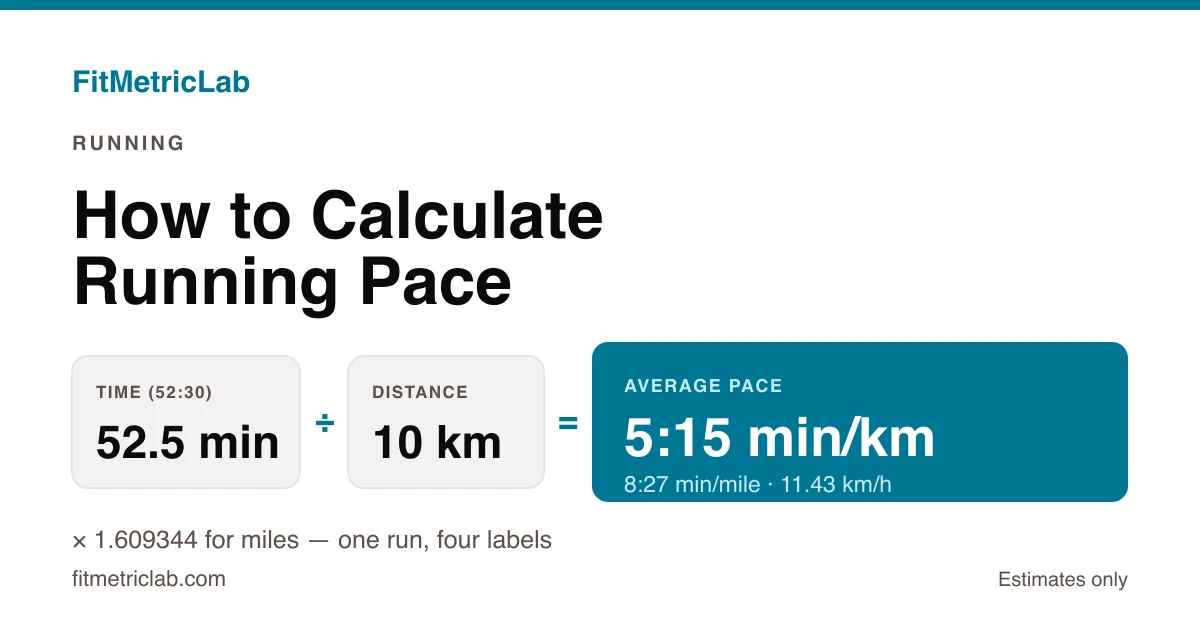
A 10 km (6.21 mile) run finished in 52 minutes 30 seconds works out at 5:15 per kilometre. The same run is also 8:27 per mile. Two numbers that look nothing like each other, and both of them describe one runner, one route and one clock.
Pace is the plainest measure in running: the time taken to cover one unit of distance. Learning how to calculate running pace by hand takes one division and one multiplication, and the running pace calculator does both in a single step: what follows is the method underneath it, in metric and imperial, with every figure reproducible from the inputs.
What running pace actually measures
Pace is time divided by distance. It answers one narrow question: how long does a single kilometre, or a single mile, take at the rhythm being run? A pace of 5:15 per kilometre means each kilometre of that run took five minutes and fifteen seconds on average.
Speed asks the opposite question, which is how much ground fits inside one hour. Pace and speed describe identical movement, so 5:15 min/km, 8:27 min/mile and 11.43 km/h (7.10 mph) are three readings of one run rather than three separate facts about it.
Pace is the reciprocal of speed, but only when the units match. In the units runners actually use there is a factor of 60 sitting between them, because minutes per kilometre meets kilometres per hour. Pace in min/km equals 60 divided by speed in km/h, so 60 divided by 11.4286 returns 5.25. Drop that 60 and the two figures stop agreeing.
Why do runners use pace rather than speed?
A pace figure travels. Multiply it by any distance and a finish time falls out, which is why a number from a Tuesday evening run projects onto a race four times the distance. Speed needs a detour through hours before it lands anywhere useful on race day.
Pace also crosses borders, provided the unit is stated. Most of the world signs roads in kilometres. The United States and the United Kingdom are the two large exceptions still signing in miles. Ireland gets lumped in with them regularly and should not be: its road distances have been metric for decades, and its speed limits switched to km/h in 2005.
Race distances are a separate matter from road signage. World Athletics recognises road records at 5 km (3.11 miles), 10 km (6.21 miles), the half marathon at 21.0975 km (13.11 miles) and the marathon at 42.195 km (26.22 miles). It also recognises them at one mile and ten miles, both still common in American road racing.
So a runner can train past mile markers and race in kilometres, or do the exact reverse. Neither is unusual.
What pace does not capture is what the run cost. The 2024 Adult Compendium of Physical Activities indexes the energy cost of running in speed bands, so a single band covers everyone moving at that speed. Two runners holding 8:27 per mile can differ in oxygen uptake, body mass and running economy, and the pace figure says nothing about any of it. That gap is the subject of a separate post on how many calories running burns.
The arithmetic, at least, does not age. A minute is a minute and a kilometre is a kilometre, so a pace worked out this morning compares directly with one worked out in 1975.
How to calculate running pace, step by step
The running pace formula has three moving parts: a distance, a time, and a decision about which unit the answer lands in. The catch sits in the middle.
A time written as 52:30 is not a number anything can divide, so the seconds have to become a fraction of a minute first. Thirty seconds is 0.5. Forty-five is 0.75. Twenty is 0.3333.
After that it is a single division. To convert min/km to min/mile, the result is multiplied by 1.609344, because one international mile is defined as exactly 1.609344 kilometres.
pace (min/km)   = total time (min) ÷ total distance (km)
pace (min/mile) = total time (min) ÷ total distance (mile)
pace (min/mile) = pace (min/km) × 1.609344
pace (min/km)   = pace (min/mile) ÷ 1.609344
speed (km/h)    = total distance (km) ÷ total time (h)
speed (m/s)     = total distance (m) ÷ total time (s)
Where:
- total time = the elapsed duration of the run, in decimal minutes (min) or hours (h)
- total distance = the ground covered, in kilometres (km) or miles (mile)
- pace = minutes per kilometre, written min/km, or minutes per mile, written min/mile
- speed = kilometres per hour (km/h), miles per hour (mph), or metres per second (m/s)
- 1.609344 = kilometres in one international mile, an exact defined value rather than a rounded one
Then the decimal answer has to travel back into clock format, and this is the step that gets dropped. A result of 5.25 min/km carries 0.25 of a minute in its tail; 0.25 multiplied by 60 returns 15 seconds, giving 5:15. Written the other way round, 5:25 is 5.4167 in decimal, which sits ten seconds per kilometre away from 5.25.
When only a pace figure is to hand and no distance or time, the pace converter for min/km to min/mile does the multiplication on its own and returns km/h alongside it.
A worked example
A runner covers 10 km (6.2137 miles) in 52 minutes 30 seconds. Every figure below carries its full decimal value forward, and rounding happens once, at the end.
Step 1, convert the time. Thirty seconds divided by 60 is 0.5, so 52 minutes 30 seconds becomes 52.5 minutes.
Step 2, divide time by distance. 52.5 divided by 10 returns 5.25 minutes per kilometre.
Step 3, convert the decimal tail. 0.25 multiplied by 60 gives 15 seconds, so the metric pace reads 5:15 min/km.
Step 4, convert to miles. 5.25 multiplied by 1.609344 returns 8.449056 minutes per mile. The 0.449056 tail multiplied by 60 gives 26.94 seconds, which rounds to 8:27 min/mile.
Step 5, cross-check the mile figure. Take the long way instead: 10 divided by 1.609344 is 6.2137 miles, and 52.5 divided by 6.2137 returns 8.449056 minutes per mile again. Two independent routes landing on the same number is the cheapest sanity check available.
Step 6, express it as speed. 52.5 minutes is 0.875 hours, and 10 divided by 0.875 returns 11.43 km/h, or 7.10 mph. In SI units, 10,000 metres divided by 3,150 seconds gives 3.17 m/s. None of these is a different run; they are four ways of labelling the same one.
A locked average pace then projects onto other distances. Held at 5:15 per kilometre, a half marathon takes 1:50:46 and a marathon 3:41:31, both rounded to the nearest second. The running splits calculator breaks a projection like that into cumulative times at each marker rather than one finish figure.
It is worth being clear about what that is, though: arithmetic, not prediction. It assumes an even effort that no long race actually delivers.
How to use the Running Pace Calculator
The running pace calculator takes two inputs. Distance goes in first, with a metric/imperial toggle that switches the field between kilometres and miles. Time goes in second, in minutes.
That second field is the one to watch, because it wants decimal minutes rather than clock minutes. A 52:30 run is entered as 52.5, not 52.30. Step 1 above is not optional; the tool assumes it has already been done. Longer runs convert the same way, so a 1:45:00 half marathon goes in as 105 minutes against 21.0975 km (13.11 miles).
The output gives pace in min/km and min/mile together, speed in km/h, and the total elapsed time as hours, minutes and seconds. Reading across that row is the quickest way to check a figure from somewhere else. A treadmill console, a sports watch and a race results page routinely report one run in three different units. For mph or m/s, the speed converter for mph, km/h and m/s takes the km/h figure the pace tool returns.
Two things are worth knowing before reading the output. The average pace covers the whole distance entered and nothing inside it. A run with a slow first kilometre and a fast last one returns exactly the same figure as a metronomic one.
The other is precision. The tool carries the exact mile factor, 1.609344, through the conversion and rounds once, when the figure reaches the screen, which is the same discipline the worked example applies by hand. Entering 10 km against 52.5 minutes returns 5:15 min/km and 8:27 min/mile, matching step 4 to the second.
Common scenarios
Training past mile markers, racing in kilometres
American and British runners train against mile signage and then race distances measured in kilometres. The two systems collide at the start line, where a target of 8:27 per mile has to be held against kilometre markers reading 5:15. Both figures come from one running pace formula applied twice against two different units. Converting the target the night before is a good deal easier than attempting the sum at 6 km with a heart rate of 170.
Treadmills, which display speed rather than pace
Treadmill consoles show speed, and the unit follows the market the machine was sold into: mph in the United States, km/h almost everywhere else. A belt at 12.0 km/h is 7.46 mph, 5:00 min/km and 8:03 min/mile. Four labels, one belt. The treadmill pace converter takes the speed in mph and returns both pace units.
Incline is a separate problem, and a sneaky one. Raising the gradient changes what the run costs without touching the belt speed, so the pace figure sits perfectly still while the effort climbs. Vertical gain has its own arithmetic, which the elevation-adjusted pace calculator handles separately.
Track sessions built on 400 m repeats
One lap of lane one on a standard outdoor track is 400 m (1,312 ft), or 0.4 km. At 5:15 per kilometre, a lap takes 126 seconds, which is 2:06, and four laps cover 1,600 m in 8:24. Track work is where pace arithmetic becomes most visible, because the distance is fixed and the clock is the only thing that moves.
One detail trips people up here: 1,600 m is not a mile. A mile is 1,609.344 m, so it runs 9.34 m longer, which at this pace is roughly three extra seconds. Four laps in 8:24 extrapolates to 8:27 for the full mile, and the two get quoted as though they were the same thing.
Triathlon, where three units share one session
Triathlon and duathlon force three measurement habits into a single session. Swimming is recorded as minutes per 100 m, cycling as km/h or mph, and running as min/km or min/mile. Three units, one athlete, no way to compare the legs as they stand.
Metres per second is the unit that reconciles them. A 1:45 per 100 m swim is 0.95 m/s, a 30 km/h (18.64 mph) bike leg is 8.33 m/s, and the 5:15 per kilometre run from the worked example is 3.17 m/s. The speed converter for mph, km/h and m/s is the shortest route to that common ground.
Common mistakes and misconceptions
- Reading 5:15 as 5.15. Clock format and decimal format look almost identical and differ by real time. Over 10 km, the gap between 5.15 and 5.25 minutes per kilometre is a full minute of finish time.
- Rounding the mile factor early. Using 1.6 instead of 1.609344 turns 5:15 min/km into 8:24 min/mile rather than 8:27. Three seconds a mile looks harmless until it is carried across the 26.2 miles of a marathon, where it shifts the projected finish by about 1 minute 17 seconds.
- Mixing units mid-calculation. Dividing a distance in kilometres by a time that produced a mile pace returns a number that is neither. The unit has to be settled before the division, not after it.
- Treating an average as a constant. An average pace summarises a whole run. The splits inside it can swing widely without changing that summary at all, so comparing an average against a single split compares two different measurements.
- Assuming a device distance matches the course distance. Satellite measurement and a certified course rarely agree exactly, and consumer GPS drifts further in urban canyons and under dense tree cover. Say a watch records 10.2 km on a certified 10 km. The pace it reports reads 5:09 rather than 5:15, and the runner has gained six seconds a kilometre that never happened.
- Reading pace as a measure of effort. Pace records ground covered per unit of time and stops there. Gradient, surface, wind, heat, altitude and body mass all change what a given pace costs the person producing it. Two runners sharing a pace can be working nowhere near as hard as each other.
Frequently asked questions
How do you work out running pace?
Divide total time by total distance, keeping both in units that match. A time written as minutes and seconds converts to decimal minutes first: 52 minutes 30 seconds becomes 52.5, because 30 divided by 60 is 0.5. Dividing 52.5 by 10 km returns 5.25 minutes per kilometre.
The decimal tail then converts back to seconds, so 0.25 multiplied by 60 gives 15, and the pace reads 5:15 per kilometre. The same time over the same distance in miles returns 8:27 per mile. Both describe one run, and the running pace calculator produces both from a single distance and time entry.
What is the difference between running pace and running speed?
Pace and speed answer opposite questions. Pace divides time by distance and gives the time for one kilometre or one mile. Speed divides distance by time and gives the ground covered in an hour. A run at 5:15 per kilometre is the same run as 11.43 km/h (7.10 mph), or 3.17 m/s.
Because they are inverses, a lower pace figure and a higher speed figure both mean faster running. That is exactly why a treadmill display and a sports watch can seem to contradict each other sitting side by side. Race planning tends to favour pace, since a race is a fixed distance and pace multiplies straight into a finish time.
How do you convert min/km to min/mile?
Multiply the pace in minutes per kilometre by 1.609344, the exact number of kilometres in one international mile. A pace of 5.25 minutes per kilometre becomes 8.449056 minutes per mile, which reads as 8:27 once the decimal tail is turned back into seconds.
Going the other way, divide the minutes per mile figure by 1.609344, so 8:00 per mile returns 4:58 per kilometre. Rounding partway through is what produces small disagreements between two figures describing one run: the full decimal value carries through every step, and rounding happens once, at the end.
What pace does a four-hour marathon need?
A marathon is 42.195 km, so four hours divides as 240 minutes by 42.195, returning 5.6879 minutes per kilometre, or 5:41. In imperial units the marathon measures 26.2188 miles, and 240 divided by that figure returns 9.1538 minutes per mile, or 9:09.
Both readings are averages across the whole distance rather than a pace held continuously, and terrain, wind and fatigue move the real splits around that mean. Entering a target time and the race distance into the running pace calculator returns the required figure in both unit systems at once.
Sources and methodology
The conversion factor used throughout, one international mile equals exactly 1.609344 kilometres, comes from the published standard rather than a rounded approximation. Every worked figure was derived from first principles and cross-checked by a second route, as shown in step 5 of the worked example.
- NIST Special Publication 1038, The International System of Units (SI): Conversion Factors for General Use, which lists the international mile as exactly 1.609344 km and miles per hour as exactly 1.609344 km/h.
- World Athletics, Marathon discipline, which sets the marathon at 26 miles 385 yards, or 42.195 km, the figure used in the projections above.
- 2024 Adult Compendium of Physical Activities, which indexes the energy cost of running by speed band and shows why pace alone does not describe physiological cost.
Putting it together
Pace is one division and one multiplication, and nearly every disagreement between two running numbers traces back to one of them. Time has to reach decimal minutes before anything is divided, and the exact mile factor has to survive to the end before anything is rounded.
Handle those two and 5:15 per kilometre, 8:27 per mile, 11.43 km/h and 3.17 m/s stop looking like four separate facts. They start looking like one run described four ways. Running the same inputs through the running pace calculator collapses the sequence into a single entry, which leaves the runner free to argue about the training instead of the maths.
Last updated 9 August 2026.