How to Predict Marathon Time from a Recent Race
A half marathon in 1:45:00 does not double into a 3:30:00 marathon. This guide works through how to predict marathon time with the Riegel formula, step by step, and shows where the estimate runs faster than the day itself.
JCVerified Verified by Jobi Cheriyan, Founder & Builder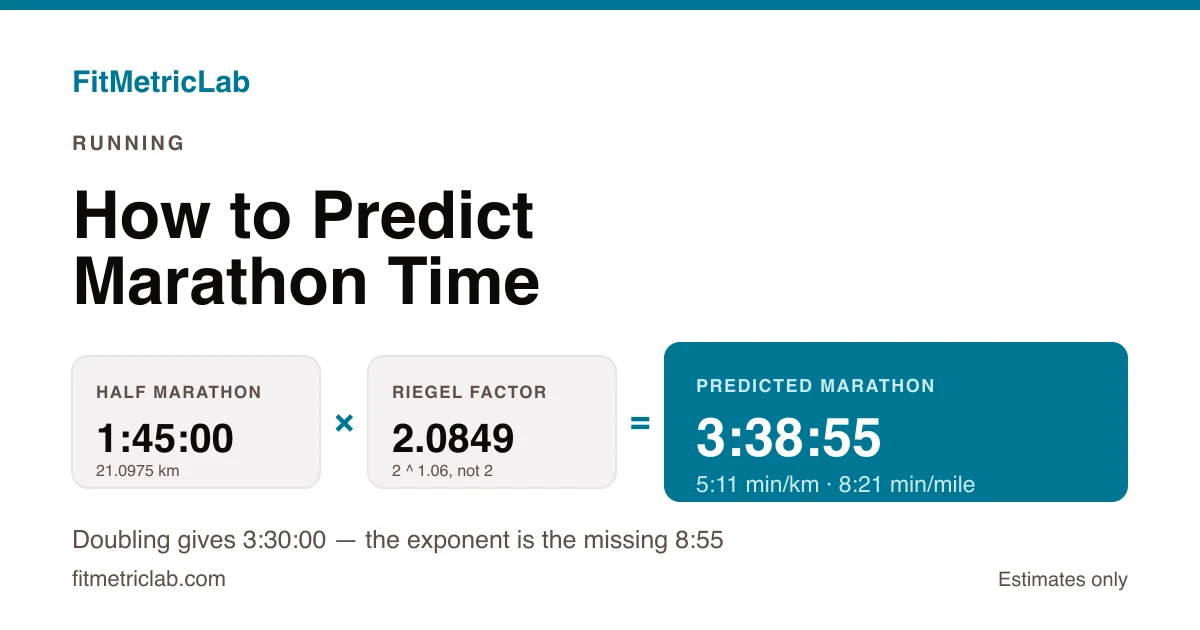
A runner crosses the line of a half marathon in 1:45:00 and does the obvious sum on the walk back to the car. Double it, call it 3:30:00, enter the marathon. The Riegel formula returns 3:38:55 for that same runner, and the race day evidence suggests even that sits on the optimistic side. Those missing 8:55 are the reason race predictors exist at all.
What follows is how to predict marathon time from a race already sitting in the logbook. It covers the arithmetic, the single assumption the method rests on, and the places where the estimate drifts furthest from the day itself. Every figure here was worked from the formula rather than copied from a table, so each step can be checked by hand or reproduced in the marathon time predictor.
What a race time prediction actually is
A race time prediction converts a finishing time you already own at one distance into an estimated finishing time at another. It takes two inputs and one assumption. The inputs are the distance and the time of a race already completed. The assumption is how much a runner slows per unit of extra distance, compressed into a single number.
That is the whole model. It holds no measure of training volume, no long run history, no terrain, no weather, no fuelling plan. A predictor treats two runners with matching 10 km (6.21 mi) results as identical marathoners. One may have run 80 km (roughly 50 miles) a week for two years while the other has never gone past 15 km (9.3 mi).
Knowing how narrow the model is makes the output usable. The estimate describes pure speed carried forward from one distance to another. It says nothing about a particular Sunday morning in October. Neither input can describe a runner running out of fuel past the 32 km (20 mile) mark, so the model never sees it coming.
The question of how to predict marathon time reduces, in the end, to choosing that single assumption well. Everything else is multiplication.
Why the marathon is where prediction breaks down
Prediction error is not spread evenly across race distances. Extrapolating from 5 km to 10 km asks the body a similar question twice over. Extrapolating from a half marathon to a full one crosses into territory where glycogen availability, thermoregulation and plain muscular durability start deciding the outcome alongside aerobic fitness.
The clearest evidence on this comes from a survey of 2,303 recreational endurance runners by Andrew Vickers and Emily Vertosick, published in BMC Sports Science, Medicine and Rehabilitation in 2016. They tested Riegel formula marathon prediction against what runners actually reported, and checked the shorter distances the same way. Up to the half marathon the formula was well calibrated. At the marathon it was not.
Their finding was specific. Riegel predictions came out at least ten minutes too fast for about half the runners in the validation group. Measured as mean squared error against observed marathon times, Riegel scored 380.7, while two models built from prior race data and weekly training mileage scored 227.6 and 208.3. The formula still carried real information, and its error ran in one consistent direction.
That direction matters more than the size of the error. A runner who sets off slightly too slow can usually claw the time back over the closing kilometres. A runner who sets off slightly too fast almost never does. Vickers and Vertosick built that asymmetry into their scoring, weighting an overestimate of speed twice as heavily as an underestimate of the same size.
How to predict marathon time with the Riegel formula
The method traces back to Peter Riegel, who set out the approach in Runner's World in 1977 and published the underlying analysis in American Scientist in 1981. He fitted a power curve to record performances across a wide span of endurance events, and the shape it found was simple. Plot the logarithm of time against the logarithm of distance and the points fall close to a straight line. Time, in other words, scales as distance raised to a fixed power.
In plain English, take the ratio between the new distance and the old one, raise that ratio to a power slightly greater than 1, then multiply the known time by the result. The power sits above 1 because runners slow as races lengthen. A power of exactly 1 would describe someone holding identical pace from 5 km to 100 km, which nobody has ever managed.
T2 = T1 x (D2 / D1) ^ 1.06Where:
- T2 = estimated time for the target race, in seconds
- T1 = known finishing time for the race already run, in seconds
- D2 = target distance in kilometres, so 42.195 km (26.22 mi) for a marathon
- D1 = distance of the completed race in kilometres, for example 21.0975 km (13.11 mi) for a half marathon
- 1.06 = the fatigue exponent, a dimensionless constant
Distances can go in as miles rather than kilometres without changing the answer, since only the ratio between them enters the formula. Mixing the two units inside one calculation is what breaks it. Spelling varies by region, with kilometre and metre across most of the English speaking world and kilometer and meter in the United States. The distances are identical either way.
The exponent carries all of the modelling weight. Riegel put it at roughly 1.08 for elite performers, and at around 1.05 to 1.06 for recreational male runners in the 40 to 70 age band. The value of 1.06 became the default in published race calculators, and it is the constant behind every figure on this page.
Riegel also put a boundary on where the relationship holds: efforts lasting roughly 3.5 to 230 minutes, across running, swimming and walking. That upper limit matters for marathon work. Priya's estimate of 3:38:55 is 219 minutes and sits just inside it, while a four hour finish at 240 minutes falls outside the window the original paper described altogether.
One caveat belongs with the study result above. Vickers and Vertosick ran their test using 1.07 as a midpoint, with sensitivity checks at 1.06 and 1.08. That is a slightly more conservative constant than the 1.06 used here. Raising it to 1.08 improved their estimates a little, and marathon speed was still overestimated for around three quarters of runners.
A worked example, step by step
Priya has one recent result worth using: a half marathon over 21.0975 km (13.11 mi) in 1:45:00. She wants an estimate for a marathon at 42.195 km (26.22 mi).
Step 1: convert the known time. 1 hour 45 minutes is 105 minutes, which is what goes into the calculator's input box. Working the arithmetic by hand is easier in seconds, and 105 x 60 = 6,300 seconds. Seconds head off the slips that creep in when hours and minutes get multiplied directly.
Step 2: form the distance ratio. 42.195 divided by 21.0975 = 2. A marathon is exactly twice a half marathon, which makes this example clean enough to check mentally.
Step 3: raise the ratio to the exponent. 2 raised to the power 1.06 = 2.0849. This is the number that separates the formula from simple doubling. The extra 0.0849 is the model's entire account of what a second half does to a runner.
Step 4: multiply. 6,300 x 2.0849 = 13,135 seconds.
Step 5: convert back. That total reads as 3:38:55 on a race clock. Rounding happens here and nowhere earlier.
T2 = 6300 x (42.195 / 21.0975) ^ 1.06
   = 6300 x 2.0849
   = 13135 seconds
   = 3:38:55
Reading the result as pace tells the story better than the finishing time does. Priya's half marathon ran at 4:59 per kilometre (8:01 per mile). The marathon estimate sits at 5:11 per kilometre (8:21 per mile). The formula is asking her to give up about 13 seconds per kilometre, or 20 seconds per mile, across the longer distance.
Set that against the sum on the walk back to the car. Doubling 1:45:00 gives 3:30:00, the formula gives 3:38:55, and the 8:55 between them is what a naive double quietly ignores. The Vickers and Vertosick data suggests a further ten minutes on top would still sit inside the normal range, which puts a realistic band closer to 3:48:55.
How to use the Marathon Time Predictor
The marathon time predictor takes a single input: half marathon finishing time, entered in minutes. Priya's 1:45:00 goes in as 105. The tool applies the 1.06 exponent across the fixed 21.0975 km to 42.195 km ratio. It returns an estimated marathon finishing time and the average pace that implies, in minutes per kilometre.
Reading the pace line first is the more useful habit. A finishing time only lands once the race is over, while a pace is something a runner can check on a watch at kilometre 3 and act on. For the same figure in minutes per mile, the pace converter (min/mile to min/km) handles the swap.
Half marathon is the only starting distance that tool accepts, which is deliberate, since it is the distance where Riegel extrapolation holds up best. For any other input race, the race time predictor (Riegel formula) applies the same arithmetic to any pair of distances. It asks for a known distance, a known time in minutes and a target distance, with a metric or imperial toggle for the distance fields. It also runs downward, from a long race to a short one.
One approach worth trying: run the calculation twice, using two different past races. If a 10 km result and a half marathon result land within a few minutes of each other, the estimate sits on firm ground. If they diverge, the runner's own fatigue curve is steeper or shallower than 1.06, and the longer race is the more trustworthy input.
Common scenarios
Stepping up from a half marathon to a first full marathon
To predict marathon time from half marathon evidence is to ask the model its easiest question, because the input distance sits closest to the target. Priya's 1:45:00 returning 3:38:55 is the worked example above. For a first marathon, one sensible reading treats that figure as the fast edge of a range rather than its centre, with the range running out to roughly ten minutes beyond it.
Working from a 5 km when nothing longer exists
Marcus has one recent result and nothing longer: 22:00 over 5 km (3.11 mi). Entering 5 as the known distance, 22 as the known time and 42.195 as the target returns a marathon estimate of 3:31:00.
The arithmetic is no weaker for the short input. With the exponent fixed at 1.06, a runner sitting exactly on that curve gets the same marathon figure whether the input is a 5 km, a 10 km or a half marathon: what the single race cannot do is check whether Marcus sits on the curve at all. Speed over 5 km says very little about what happens at 30 km, so the estimate leans almost entirely on a fatigue assumption borrowed from other people.
When two of your own races disagree
Marcus later runs a half marathon in 1:45:00. That race returns 3:38:55, while his 5 km still returns 3:31:00, and the 7:55 between the two figures is the useful part.
A gap in that direction means his own fatigue curve runs steeper than 1.06. Solving the same equation for the exponent rather than the time gives 1.0856 across his two races, and applying that constant returns 3:42:50 from either one. The better performing of the two Vickers and Vertosick models works on this principle, deriving the exponent from a pair of prior races instead of assuming a single value for everybody.
Turning an estimate into a pacing plan
An estimate of 3:38:55 only earns its keep once it becomes something to execute. That means converting the average pace of 5:11 per kilometre (8:21 per mile) into kilometre or mile markers, which is what a marathon splits calculator does. Runners who split a predicted time evenly tend to find the opening kilometres absurdly easy, which is the intended sensation and the hardest part to accept.
Coming back after a long gap
Old race results decay as predictors. A half marathon from three years ago and one from three weeks ago produce identical formula output, and only one of them describes the runner standing on the start line. There is no time term anywhere in the equation, so staleness is invisible to it.
Where the most recent race is not recent, a fresh time trial makes the better input. A hard 5 km on a flat loop costs an hour of the week and tells the formula something true.
Common mistakes and misconceptions
- Treating the estimate as a target. The number describes what current speed would produce under even pacing with nothing going wrong. Marathons rarely offer that. Reading the output as a ceiling changes race day decisions in the direction the evidence supports.
- Feeding in the shortest available race. For most runners a 5 km result produces a more optimistic estimate than a half marathon result, because their own fatigue curve is steeper than the 1.06 the formula assumes: where several past races exist, the longest is usually the most informative input.
- Mixing units inside the calculation. Entering distance in miles and reading pace in minutes per kilometre is a common slip. Both distances in the ratio have to share a unit. Regional habits differ too, with pace commonly quoted per mile in the United States, the United Kingdom and Ireland, and per kilometre across most of Europe and Asia.
- Assuming the exponent is universal. Swap 1.06 for 1.02 on Priya's input and her estimate lands at 3:32:56. Push the same constant to 1.15 and it returns 3:53:01. One digit almost nobody sees moves the answer across a twenty minute band, which is worth knowing before the output gets treated as precise.
- Confusing prediction with fitness scoring. A predicted time is not a fitness rating, and the two answer different questions. A VDOT calculator (Jack Daniels) maps a performance onto an oxygen cost scale and derives training paces from it, which is a separate exercise from extrapolating a finishing time.
Frequently asked questions
How accurate is it to predict marathon time from half marathon results?
Accurate enough to plan around, loose enough that treating it as a promise causes trouble. The Riegel formula was fitted to record performances. The large survey of recreational runners by Vickers and Vertosick found it well calibrated up to the half marathon distance and poorly calibrated at the full marathon. Among the runners they checked, the shortfall was blunt: half the field crossed the line ten minutes or more behind what the arithmetic had promised. One practical reading takes the figure the formula returns and treats anything within roughly ten minutes on the slower side as normal. The estimate describes a runner holding form for the whole distance, and the closing stretch is where form tends to go.
Can marathon time be predicted from a 5 km or 10 km race?
Yes, and the arithmetic is identical whichever distance goes in. A 22:00 result over 5 km (3.11 mi) returns a marathon estimate of 3:31:00. The catch sits in the assumption rather than the sum. With the exponent fixed at 1.06, a runner sitting exactly on that curve gets the same answer from a 5 km, a 10 km (6.21 mi) or a half marathon. A short input is not arithmetically weaker. Real runners rarely sit on the curve. Someone with sharp speed and a thin long run history slows faster than 1.06 describes, and a 5 km result has little way of revealing it. A recent half marathon asks the body a question closer to the one a marathon asks.
Why does doubling a half marathon time not work?
Doubling assumes pace holds constant as distance grows, and it does not. Runners slow as a race lengthens, which is why the Riegel formula raises the distance ratio to a power slightly above one instead of multiplying straight through. For the half to full step the ratio is exactly 2, and 2 raised to 1.06 comes to 2.0849 rather than 2. On a 1:45:00 half marathon that difference is worth 8:55, the gap between a doubled 3:30:00 and a formula estimate of 3:38:55. The exponent is the entire model: one number standing in for fatigue, fuelling and pacing across the extra distance.
What exponent do marathon time predictors use?
Most use 1.06, which is the value carried by the widely copied race time calculators and the constant behind the figures on this page. Riegel's own paper placed it nearer 1.08 among the fastest performers, and down in the 1.05 to 1.06 band for older recreational men. A single universal value was never the claim. The sensitivity is worth seeing. Applied to a 1:45:00 half marathon, an exponent of 1.02 returns 3:32:56, 1.06 returns 3:38:55, and 1.15 returns 3:53:01. That is roughly a twenty minute spread from a change most runners would call a rounding difference.
Sources and methodology
Every figure on this page was derived from the formula rather than copied from a table, and each can be reproduced with a calculator using the steps in the worked example. Times were computed in seconds and converted to hours, minutes and seconds only at the final step, so no intermediate rounding carries forward. Distances follow the standard 42.195 km for the marathon and 21.0975 km for the half marathon. Every Riegel formula marathon prediction quoted here uses an exponent of 1.06.
The formula comes from Peter Riegel, who introduced it in Runner's World in 1977 and published the supporting analysis of record performances in American Scientist in 1981. The empirical test of how it behaves for ordinary runners comes from Vickers and Vertosick. Their open access paper covers 2,303 recreational endurance runners and measures the calibration of Riegel predictions at each race distance, using an exponent of 1.07 with sensitivity checks at 1.06 and 1.08.
- Riegel, P. S. Athletic Records and Human Endurance. American Scientist, volume 69, pages 285 to 290
- Vickers, A. J. and Vertosick, E. A. An empirical study of race times in recreational endurance runners. BMC Sports Science, Medicine and Rehabilitation, volume 8, article 26
Putting it together
The arithmetic of marathon prediction is small enough to do on paper: a distance ratio, an exponent of 1.06, one multiplication. What it cannot see is everything else a marathon tests, which is why a 1:45:00 half marathon returns 3:38:55 while the runner who produced it may well finish nearer 3:48:55. Both figures inform, once the gap between them reads as fuelling, heat and durability rather than as error. The fuelling half of that gap has arithmetic of its own, worked through in how many calories running burns.
Taken as a speed statement and a pacing anchor, the marathon time predictor earns its place in the planning. Taken as a guarantee, it sets up the kind of closing stretch most runners only need to experience once.
Last updated 11 August 2026.