How Many Calories Does Rowing Burn?
Rowing calorie estimates rest on a MET value, body mass and duration. This guide works the formula through step by step, shows why a Concept2 monitor reads about 110 kcal higher on the same 30 minutes, and sets out where the estimate holds and where it drifts.
JCVerified Verified by Jobi Cheriyan, Founder & Builder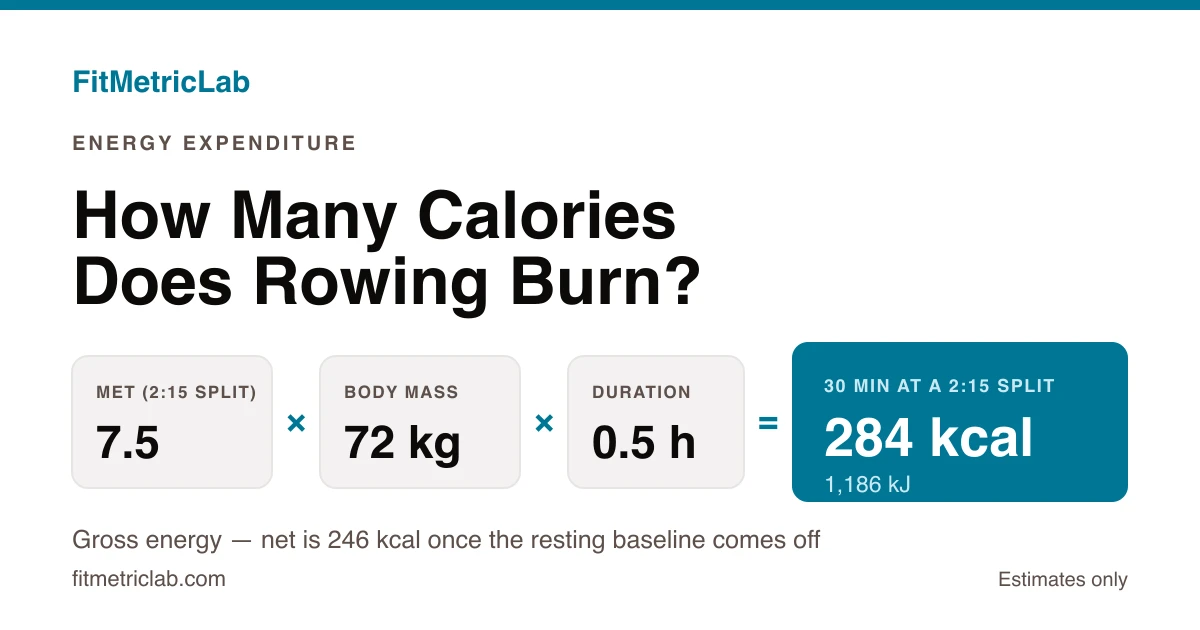
A 72 kg (159 lb) rower holding a 2:15 split for half an hour spends about 284 kcal (1,186 kJ) on the standard MET method. Put a 55 kg (121 lb) rower on the same machine at the same pace and the estimate falls to 217 kcal. Put a 95 kg (209 lb) rower on it and it climbs to 374 kcal. Same stroke, same clock, a 157 kcal spread, none of it caused by effort. So how many calories does rowing burn? The figure tracks the body doing the work at least as closely as it tracks the work.
Rowing is also one of the few activities where intensity can be read off a screen instead of guessed at. That makes the estimate more defensible than most. It also makes the gap between the monitor total and the published tables harder to ignore once you spot it. What follows is the method behind every figure quoted here: where the MET values come from, how the arithmetic runs, and why the machine disagrees with the table. The rowing calorie burn calculator runs the same formula, so every number below can be reproduced rather than taken on trust.
What a rowing calorie estimate actually measures
The estimate models whole-body energy expenditure across a fixed block of time. Three things build it: how hard the work is, how heavy the body doing it is, and how long it lasts. Intensity comes in as a MET value. The metabolic equivalent of task, the ratio of working metabolic rate to resting metabolic rate. One MET is defined as an oxygen uptake of 3.5 millilitres per kilogram per minute, which is roughly what a seated adult uses doing nothing.
Multiply that ratio by body mass and by duration and out comes a figure in kilocalories: what it describes is a population average for that activity, drawn from people who were measured in a lab. It is not a reading taken from the rower in front of the machine.
One piece of vocabulary travels badly. The Calories printed with a capital C on labels in the United States and Canada are kilocalories, written kcal in most scientific work. Labels across the UK, Ireland and the EU carry both units, and Australian and New Zealand labels lead with kilojoules. One kcal is 4.184 kJ, and nothing else in the arithmetic changes between markets.
Why the number is worth estimating at all
Rowing sits in an unusual spot in the energy expenditure literature. Most activities carry MET values pinned to loose effort descriptors (light, moderate, vigorous) which leaves the reader guessing which row of the table applies. Indoor rowing is catalogued by measured power output in watts instead, alongside stationary cycling and arm ergometry. Ski ergometers, for contrast, are still banded by speed. A monitor reading maps onto a band, and the guesswork drops out of that step.
The precision is real, and it is bounded. The Compendium's own guidance is blunt about this. It was built to standardise intensity across population studies, not to pin down the energy cost of an activity within one person, and it corrects for neither age nor sex nor body mass. Kozey and colleagues found the standard MET misclassifies the intensity category 12.2 per cent of the time against measured values. The misses cluster in people who are heavier, older, less fit, or women.
Two things push the error in a predictable direction. Well-trained rowers are more economical at a given wattage and tend to sit below the modelled figure. Body composition pulls the other way. The formula scales with total mass, while metabolically active tissue does not. So the estimate drifts high for rowers carrying more fat mass, and low for very lean ones at the same weight.
How many calories does rowing burn: the calculation
Two steps. Place the session in an intensity band to get a MET value, then combine that value with body mass and duration.
Energy (kcal) = MET x 3.5 x body mass (kg) x duration (min) / 200

Where the monitor shows pace rather than power:
Power (watts) = 2.80 / (seconds per metre) ^ 3
Every term, with its units:
- MET, the intensity ratio, dimensionless, taken from the published row matching the wattage band.
- 3.5: oxygen uptake at rest, in millilitres per kilogram per minute.
- Body mass. Kilograms. One kilogram is 2.2046 lb; one stone, still in everyday use in the UK and Ireland, is 6.35 kg.
- Duration: minutes of active work, with rest between pieces left out.
- 200. The constant that turns millilitres of oxygen per minute into kcal per minute. It bundles roughly 5 kcal per litre of oxygen with a factor of 1,000.
- Seconds per metre. The 500 m split in seconds divided by 500. A 2:00 split is 120 seconds, or 0.24 seconds per metre.
One caveat on that second line, and it matters more than it looks. The cube relation between pace and power is Concept2's, derived for an air-braked flywheel where drag rises with the cube of speed. Water-braked and magnetic machines use their own drag curves and their own displayed wattage, so a split from one brand does not convert cleanly using another brand's constant: where a machine shows watts directly, the wattage is the safer input.
MET values for rowing, and the splits that go with them
The MET value for rowing depends entirely on which wattage band the session lands in. The 2024 Adult Compendium bands indoor rowing four ways, and those values shifted in that revision. The 2011 edition put the top band at 12.0 rather than 14.0, which is why older calculators and older articles still circulate lower numbers.
| Code | Activity | MET | Split, Concept2 relation |
|---|---|---|---|
| 02071 | Stationary ergometer, under 100 watts, moderate effort | 5.0 | slower than 2:32 |
| 02072 | Stationary, 100 to 149 watts, vigorous effort | 7.5 | 2:31 to 2:13 |
| 02073 | Stationary, 150 to 199 watts, vigorous effort | 11.0 | 2:12 to 2:01 |
| 02074 | Stationary, 200 watts or more, very vigorous effort | 14.0 | 2:00 or faster |
| 02070 | Stationary ergometer, general, vigorous effort | 7.3 | no wattage stated |
| 18070 | On the water, for pleasure, general | 3.5 | not applicable |
| 18080 | On the water, in competition, crew or sculling | 12.0 | not applicable |
The split column is worth keeping in view, because the band edges land in awkward places. A 2:15 split is a solid working pace for a club rower. It still sits in the 100 to 149 watt band, 2.4 seconds per 500 m short of the next one up. Shaving three seconds off that split takes the session to 152 watts, moves the MET value from 7.5 to 11.0, and lifts the estimate by nearly half. The formula has no opinion about how close to the edge a session finished.
Code 02070 covers the case where the monitor is dead, missing or showing something else entirely. At 7.3 MET it sits just below the 100 to 149 watt row, which is a reasonable default for someone who describes the session as hard but cannot say what wattage they held. The custom MET calculator takes a MET value directly for anyone working from a different row of the table.
A worked example, step by step
Take a 72 kg (159 lb) rower doing 30 minutes of continuous work at an average split of 2:15 per 500 m, with the monitor set to show pace rather than power.
Step 1, convert the split to power. A 2:15 split is 135 seconds per 500 m, or 0.27 seconds per metre. Cubed, that is 0.019683. Dividing 2.80 by 0.019683 gives 142.3 watts.
Step 2, pick the MET value. 142 watts falls inside the 100 to 149 watt band, which the Compendium rates at 7.5 MET and labels vigorous effort.
Step 3, run the formula. 7.5 times 3.5 is 26.25. Times 72 kg gives 1,890. Times 30 minutes gives 56,700. Divided by 200, that returns 283.5, which rounds to 284 kcal (1,186 kJ). The session covers 6,667 m at that pace.
Step 4, separate gross from net. Lying still for the same 30 minutes accounts for about 38 kcal at 1.0 MET, so the energy attributable to the rowing itself is nearer 246 kcal. Sources quote one or the other and rarely say which.
Running those inputs through the calories burned rowing calculator reproduces 284 kcal: how much weight that figure carries is easier to see by nudging one input. Hold the same 30 minutes three seconds faster, at a 2:12 split, and the session crosses into the 150 to 199 watt band: 11.0 MET, and 416 kcal. Three seconds of pace, 132 kcal of difference. The third digit was never worth printing.
Why the monitor and the table disagree
This is the part that sends people looking for a second opinion. Finish that session on a Concept2 and the monitor will not say 284.
Concept2 publishes its relation: calories per hour come to 300 plus four times the average watts divided by 1.1639. The 300 is a fixed allowance for hauling a body up and down the slide, which the flywheel cannot see. At 142 watts that works out at 789 kcal per hour, or 394 kcal for the half hour: 110 kcal above the MET figure, on the same session.
The whole relation is calibrated to a 175 lb (79 kg) reference rower, which is where the second correction comes in. Concept2 publishes that too: take the displayed hourly figure, subtract 300, add 1.714 times body mass in pounds. For our 72 kg rower that adjusts the half hour down to about 380 kcal. For a 55 kg rower it drops to 348; for a 95 kg rower it rises to 424. So the raw monitor total does read high for lighter rowers and low for heavier ones, exactly as the changing-room folklore has it.
Even after that correction the machine sits well above the table. The two are not competing measurements of the same quantity. The monitor starts from mechanical work at the flywheel, then grosses it up with an assumed efficiency and a fixed slide allowance. The Compendium starts from oxygen uptake measured in a lab on people doing the activity.
That is why rowing machine calories and table-based estimates rarely line up. They answer adjacent questions. Neither one measured the rower on the seat today.
How to use the Calorie Burn: Rowing tool
The rowing calorie calculator takes body mass in kilograms or pounds, session duration in minutes, and either average power output in watts or an average 500 m split: where a split goes in, the tool derives watts first and then selects the band.
The output gives the gross estimate in kcal with the kilojoule equivalent beside it, the MET value that was applied, and the resting component broken out so the net figure can be read separately. Treating that output as a range rather than a point is the main thing. Two sessions logged the same way stay comparable to each other even when both sit some distance from the truth, and that internal consistency is where the number earns its keep.
Common scenarios
A 20 minute steady row under 100 watts
A 60 kg (132 lb) rower at 5.0 MET for 20 minutes returns 105 kcal (439 kJ), falling to 84 kcal once resting metabolism comes out. The Compendium calls this band moderate effort rather than easy, which is a fair description of a sustainable conversational pace.
A 30 minute vigorous erg session
The worked example lives here: 284 kcal at 72 kg. The same 30 minutes at 55 kg (121 lb) returns 217 kcal, and at 95 kg (209 lb) it returns 374 kcal. Identical work, a 157 kcal spread across a realistic range of adult body masses.
A 20 minute hard piece at 150 to 199 watts
An 85 kg (187 lb) rower in the 11.0 MET band returns 327 kcal (1,369 kJ) across 20 minutes, or 298 kcal net. Worth noting that the Compendium still labels this band vigorous rather than very vigorous. The top rung starts at 200 watts.
Forty-five minutes on the water at an easy pace
Recreational rowing on open water is catalogued separately at 3.5 MET, so 45 minutes at 70 kg (154 lb) returns 193 kcal (807 kJ). Crew or sculling in competition sits at 12.0 MET, more than three times the rate.
Building a picture across a mixed week
Rowing logs usually sit next to other sessions, and the same formula drives the calorie burn. Swimming and calorie burn. Weight training estimates. Using one method across the week keeps the comparisons internally consistent, which matters more than any single figure. The same reasoning is worked through for road work in how many calories does running burn, and for resistance sessions in how many calories does lifting weights burn.
Common mistakes and misconceptions
- Reading the estimate as a measurement. A MET-derived figure is a group mean applied to one person, with no adjustment for age, sex or body composition. Quoting it to the kilocalorie implies a precision the method never had.
- Taking the monitor total at face value. The displayed figure comes from a different model, calibrated to a 175 lb (79 kg) reference rower, and at moderate wattages it runs well above the MET estimate for most people.
- Mixing gross and net figures from different sources. The resting component works out at about 0.525 kcal per kilogram per half hour: 26 kcal for a 50 kg rower, 53 kcal for a 100 kg one. Comparing one source's gross against another's net imports that gap before anything else is considered.
- Averaging a session that was never steady. Intervals spend time across several wattage bands, and a single MET value applied to the whole block flattens that. Splitting the session by band and adding the pieces gets closer.
- Assuming the band steps are even. They are not. The jumps run 2.5, then 3.5, then 3.0 MET, so the cost of moving up a band depends entirely on which band you started in.
Frequently asked questions
How many calories does rowing burn in 30 minutes?
For a 72 kg (159 lb) adult holding 100 to 149 watts, the MET method returns about 284 kcal (1,186 kJ) for 30 minutes. The same half hour under 100 watts returns roughly 189 kcal, and at 200 watts or more it rises to about 529 kcal. Body mass shifts the figure as hard as intensity does. At that same 100 to 149 watts, a 55 kg (121 lb) rower lands near 217 kcal and a 95 kg (209 lb) rower near 374 kcal, from the identical session. Any half-hour number quoted without both a body mass and a power output is incomplete.
Does rowing burn more calories than running or cycling?
That depends on the intensities being compared, not on the sport. Rowing is unusual in that the Compendium of Physical Activities bands it by measured wattage rather than by perceived effort. An erg piece can therefore be placed on the scale more tightly than most activities. A hard piece sits high, an easy paddle sits low, and running and cycling show the same spread. A comparison only means something when both activities come from the same MET table and are matched for duration and body mass. Cross-sport rankings quoted without those controls mostly reflect the intensity someone assumed.
Why does my rowing machine show a different calorie number?
Because it answers a different question. A Concept2 monitor works from flywheel power using its own published relation, about 300 plus four times the watts divided by 1.1639 per hour, calibrated to a 175 lb (79 kg) reference rower. At 142 watts that comes to roughly 394 kcal for 30 minutes against 284 kcal from the MET table for a 72 kg rower. Concept2 publishes a weight correction, subtract 300 and add 1.714 times body mass in pounds, which narrows the gap without closing it. Neither figure measures the person sitting on the seat.
Does rowing faster burn more calories than rowing longer?
Both terms are linear in the formula, so doubling the minutes doubles the estimate. Moving up a band is less tidy, because the steps are uneven: 5.0 to 7.5 is a jump of 2.5, then 7.5 to 11.0 is 3.5, then 11.0 to 14.0 is 3.0. Going from the 100 to 149 watt band up to 150 to 199 watts lifts the MET value by about 47 per cent for the same clock time. That puts 20 minutes at the higher band within roughly 2 per cent of 30 minutes at the lower one, so the arithmetic treats those two routes as near enough equivalent.
Sources and methodology
MET values are taken unchanged from the 2024 Adult Compendium of Physical Activities: Conditioning Exercise codes 02070 through 02074 for indoor rowing, and Water Activities codes 18070 and 18080 for rowing on the water. That edition was tailored for adults aged 19 to 59 by removing data from people aged 60 and over, so figures outside that range carry extra uncertainty.
The pace-to-power relation and the calories-per-hour relation quoted in the monitor section come from Concept2's published support material; the 175 lb reference and the weight-adjustment formula are on Concept2's own calorie calculator page. Every figure here was computed from the raw inputs, with rounding applied only at the final step. None of the rowing MET values used are flagged as estimated in the Compendium. All four wattage bands are supported by measured data.
- 2024 Adult Compendium of Physical Activities, MET value tables
- Compendium of Physical Activities, Conditioning Exercise MET table
- Compendium of Physical Activities, Water Activities MET table
- Compendium of Physical Activities, corrected METs for adults
- Herrmann and colleagues, 2024 Adult Compendium of Physical Activities, Journal of Sport and Health Science
- Concept2, Calorie Calculator and weight-adjustment formula
Putting it together
Rowing is one of the few activities where the intensity term can be pinned to a measured number rather than a description, and that makes the estimate more defensible than most. It also makes the limits easier to see. Body mass carries as much weight in the arithmetic as effort does. Gross and net differ by a predictable margin. The machine in front of the rower is answering a different question from the table, and knowing which one produced a given figure explains most of the disagreements people run into.
Logged the same way each time, the figure tracks change across weeks with reasonable fidelity, which is the job it is actually good at. Set beside other sessions through the activity calorie comparison calculator, it becomes a way of reading a training week rather than a verdict on a single row.
Last updated 7 August 2026.